The backstory: On the drive to school the other day, we were temporarily behind a shiny black car with a large sticker in the back window which read "Italian Princess." JT had questions.
JT: What is an Italian Princess?
Mama: It's an Italian girl from New Jersey.
JT: But what makes her a princess?
Mama: Big hair, long shiny fingernails, and an attitude.
JT: You forgot good pizza. We have good Italian pizza in New Jersey.
The boy makes a valid point.
Monday, October 26, 2009


Sunday, October 25, 2009
Final Harvest


Friday, October 23, 2009
Food Friday: French Onion Soup
The arrival of cooler evenings has inspired me to start making soup again. I make all sorts of soups but one of my favorites is French Onion soup. I like this recipe for onion soup so much that I almost never try French Onion at a restaurant.....I know that it won't be nearly as good.

And the very best part of this recipe is that it is so incredibly easy.
2-3 tablespoons butter
4 cups thinly sliced onions.......and thinly sliced is key, so don't mess around here
4 cups vegetable broth (cubes or pre-packaged...it doesn't matter)
2 tablespoons red or rose wine
1 teaspoon Worcestershire sauce
4-6 slices garlic toast (see my recipe)
1-2 cups shredded Swiss cheese
ground pepper
ground oregano
A note on onions: I usually use yellow onions, though sometimes I mix red and yellow. If you have a red onion on hand, use it. If not, yellow will do quite nicely.

And about the broth: I prefer vegetable broth because it's sweeter; traditional onion soup uses beef broth and that may be more to your liking.
In a large saucepan, melt the butter over medium heat. Stir in the onions; make sure they are coated in the butter. Then liberally sprinkle pepper over the onions; stir and then add a bit more pepper. Turn heat down to medium low, place a lid on the pot and let it be for 10 minutes. seriously....don't even think about lifting that lid.

While you are waiting, heat the oven to 425 degrees. Grate the Swiss cheese. But leave that pot alone!
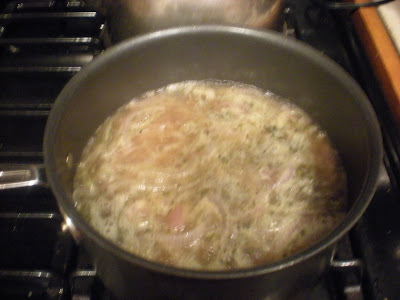
After ten minutes, stir the onions and give them a generous sprinkle with dried oregano. Add the 4 cups of broth, the wine, and Worcestershire. Bring to a rolling boil. Then reduce heat, put the lid back on, and simmer for 10 more minutes.
Your kitchen now smells amazing. At ten minutes, ladle the soup into oven-proof bowls. Top each bowl with a garlic toast or two and then the swiss cheese. Place the bowls in the oven and broil until the cheese is melted and bubbling (about 7-10 minutes).


The bowls and soup will be very hot....be careful not to burn your tongue. Serves 2-3 supper-sized servings or 4-6 appetizer servings. Yum.

Note: These pictures loaded up easy-peasy. If only I could figure out why. Sigh.

2-3 tablespoons butter
4 cups thinly sliced onions.......and thinly sliced is key, so don't mess around here
4 cups vegetable broth (cubes or pre-packaged...it doesn't matter)
2 tablespoons red or rose wine
1 teaspoon Worcestershire sauce
4-6 slices garlic toast (see my recipe)
1-2 cups shredded Swiss cheese
ground pepper
ground oregano
A note on onions: I usually use yellow onions, though sometimes I mix red and yellow. If you have a red onion on hand, use it. If not, yellow will do quite nicely.

In a large saucepan, melt the butter over medium heat. Stir in the onions; make sure they are coated in the butter. Then liberally sprinkle pepper over the onions; stir and then add a bit more pepper. Turn heat down to medium low, place a lid on the pot and let it be for 10 minutes. seriously....don't even think about lifting that lid.


Your kitchen now smells amazing. At ten minutes, ladle the soup into oven-proof bowls. Top each bowl with a garlic toast or two and then the swiss cheese. Place the bowls in the oven and broil until the cheese is melted and bubbling (about 7-10 minutes).


The bowls and soup will be very hot....be careful not to burn your tongue. Serves 2-3 supper-sized servings or 4-6 appetizer servings. Yum.

Note: These pictures loaded up easy-peasy. If only I could figure out why. Sigh.
Thursday, October 22, 2009
The Birds AND the Bees?
For a while now, JT has been in possession of the facts of life. Several pressing questions from him resulted in me laying out the sordid details about how babies are born. He took the news well, though he remains incredibly skeptical about such an arrangement. When our talk finished, I issued the standard Mama closing statement, "let me know if you have other questions."
So every once in a while, at moments when I least expect it, he asks for clarification. One morning last week, as I was getting lunches packed, he asked, "How do cats have kittens?" So I explained the process but, before I could finish, he said incredulously, "They have sex too?" I confirmed. He shook his head.....and then said, "How do they know that's what they are supposed to do? Because, honestly, Mama, it doesn't seem obvious to me."
So I went with the Mother Nature response: "When they are ready, their bodies tell them what to do."
He contemplated that and then asked the obvious next question" "What about dogs? Horses? Cows? Snakes?"
"They all have sex to make babies," I explained.
More incredulous head-shaking ensued as he wondered who, exactly, thought this insane arrangement was a good idea.
So every once in a while, at moments when I least expect it, he asks for clarification. One morning last week, as I was getting lunches packed, he asked, "How do cats have kittens?" So I explained the process but, before I could finish, he said incredulously, "They have sex too?" I confirmed. He shook his head.....and then said, "How do they know that's what they are supposed to do? Because, honestly, Mama, it doesn't seem obvious to me."
So I went with the Mother Nature response: "When they are ready, their bodies tell them what to do."
He contemplated that and then asked the obvious next question" "What about dogs? Horses? Cows? Snakes?"
"They all have sex to make babies," I explained.
More incredulous head-shaking ensued as he wondered who, exactly, thought this insane arrangement was a good idea.
Tuesday, October 20, 2009
A Statement of Southern Legitimacy
My good friend S sent me this link, from a Southern literary journal, The Dead Mule Society, which requires submitters to offer up their statement of Southern Legitimacy along with their literary submissions. S wondered what my statement might be. I am not a writer who submits things to journals of poetry or fiction. But (of course) I loved the challenge of drafting my Southern Legitimacy Statement. So I set to work.
Being southern means looking for daffodils in February, magnolia blooms in May, and lightening bugs in July, a month that you pronounce as jew-lie.
Being southern means having a front porch and a rocker.
Being southern means having your picture made as in "Y'all stand still while I make your picture with my camera."
Being southern means that when you walk through the door to the steamy outdoors in the morning you expect to have your glasses fog up .
Being southern means understanding the difference between "y'all" (a group of people) and "all y'all" (a real big group of people).
Being southern means you understand that all soda is known as "coke." From there, distinctions may be drawn, as in "Yes, ma'am, I would like a coke. I'll have a Dr. Pepper."
Being southern means understanding that macaroni & cheese is a vegetable.
Being southern means an expectation that homemade corn muffins or biscuits will be served hot and fresh with most every meal.
Being southern means eating supper, not dinner.
Being southern means knowing the difference between bourbon and Tennessee whiskey. And having a preference.
Being southern means there is a fresh pitcher of iced tea on your counter all summer long. It's called the tea pitcher.
Being southern means you can make fried chicken without a recipe.
Being southern means that grits and cornmeal are staples in your pantry.
Being southern means your baby calls you mama and when that child is a handful you sigh and say, "child, you wear me out."
Being southern means looking for daffodils in February, magnolia blooms in May, and lightening bugs in July, a month that you pronounce as jew-lie.
Being southern means having a front porch and a rocker.
Being southern means having your picture made as in "Y'all stand still while I make your picture with my camera."
Being southern means that when you walk through the door to the steamy outdoors in the morning you expect to have your glasses fog up .
Being southern means understanding the difference between "y'all" (a group of people) and "all y'all" (a real big group of people).
Being southern means you understand that all soda is known as "coke." From there, distinctions may be drawn, as in "Yes, ma'am, I would like a coke. I'll have a Dr. Pepper."
Being southern means understanding that macaroni & cheese is a vegetable.
Being southern means an expectation that homemade corn muffins or biscuits will be served hot and fresh with most every meal.
Being southern means eating supper, not dinner.
Being southern means knowing the difference between bourbon and Tennessee whiskey. And having a preference.
Being southern means there is a fresh pitcher of iced tea on your counter all summer long. It's called the tea pitcher.
Being southern means you can make fried chicken without a recipe.
Being southern means that grits and cornmeal are staples in your pantry.
Being southern means your baby calls you mama and when that child is a handful you sigh and say, "child, you wear me out."
Monday, October 19, 2009
Household Happiness: Garden Bouquets


The very first garden I planted, on my apartment balcony when I lived in Nashville, featured a few tomato plants and several pots of flowers. Each week, I would cut some of those flowers for an indoor bouquet. Almost 20 years later, my garden is a lot larger but it still includes flowers. I continue to cut bouquets for the indoors.
One of the parts of summer I enjoy the most is picking flowers for fresh bouquets each week. I plant scads of zinnias of all sorts; they are old-fashioned, hearty, colorful flowers which makes for a bouquet that can stand up to rigor of cat attacks. I plant lots of other flowers as well: marigolds (they are natural pest protection for the garden), cosmos, gladiolas, dahlias, and lilies make regular appearances in the flower beds at my house.
But the zinnias are always my favorites.; their appearance in my home is a sure sign that summer's garden bounty has arrived. As the cold weather arrives, I will pour over seed catalogs picking out the zinnia varieties that will see me through the next summer.
The seed packets will arrive by December and I'll tuck them into my kitchen cupboard, right next to the vases I use for flowers. There they will serve as a welcome reminder that spring and summer flowers are just around the corner.
Note: For the past month, I have been experimenting with a new host site for this blog. It's a long and boring story, but the upshot is that I'm not finding Blogger a great host for photo uploads. So there is another Sassafras Mama underway, over at Wordpress.com. You can find it here. It's been up for a few weeks, featuring the same posts that you can find here at the Blogger site but with easier (and better photos). If you're inclined, please pop on over. Right now it's still an experiment to see which format I like best. If you have an opinion, please let me know.
And thanks for reading.
Friday, October 16, 2009
My Politics Go Local
Though 2009 is an off-election year for most of the nation, that's not the case in New Jersey. In the Garden State, we've got elections for the Governor and the state legislature. And, as evidenced by the fact that President Obama will soon be here to campaign for the re-election of incumbent Governor Jon Corzine, the nation is watching.
In a way. that's too bad. No matter the outcome of the races here, the national news media will likely interpret it as a litmus test on Obama and the Democratically-controlled Congress. There are some big issues here but much of it is local and not reflexive of national issues.
Governor Jon Corzine is an independently wealthy businessmen who previously served as one of the state's Senators. Many in the state hoped that the Democrat's seeming independence would translate into some real political independence, at least when it came to taking on the entrenched interests in New Jersey. We hoped in vain. He hasn't been a disaster as governor, but neither has he been all that impressive. He has had some real accomplishments in the area of equalizing school district funding; he's undertaken some decent environmental initiatives. But on the question of getting the state to give up some of its costly local fiefdoms of power, Corzine has been mostly silent.
Which is not to say that I will vote for his Republican opponent, Chris Christie. As a federal prosecutor appointed by President George W. Bush, Christie racked up some decent credentials, taking on political corruption in the state. But as a candidate he's been less than impressive, expressing a litany of objections to Corzine's ideas and proposals while offering few nuts and bolts of his own. Christie's got a prickly style and doesn't like to be challenged (stunning when you consider that he's a Jersey natives...and this is a state with contentious people). He had a substantial lead in early polls and seemed eager to squirrel that away for a November victory. Lately his lead has shrunk and the race has gotten highly competitive, largely because Christie didn't bother to capitalize on his lead.
Enter a third party candidate, who joined the race in August in order to express his dissatisfaction with business-as-usual in New Jersey politics. Chris Daggett is an Independent who has served in state government, mostly for moderate Republicans. He's got volumes of education experience and a sound environmental track record (and the endorsement of some environmental groups). He has defined some good plans for taking on the state's problems (too much local control, insane property taxes, and the epidemic of pay-to-play). Daggett seems to be the real deal; so impressive that he received the endorsement of the state's leading newspaper.
I'm a liberal Democrat and under normal circumstances would cast a ballot for Jon Corzine. But I have to say that I'm giving that some very serious second thoughts to that approach this year. JT is avidly watching the race; he expects to cast a ballot in the 4th grade election at school. So we'll have plenty to talk about as we watch tonight's gubernatorial debate. Our vote lies in the balance.
In a way. that's too bad. No matter the outcome of the races here, the national news media will likely interpret it as a litmus test on Obama and the Democratically-controlled Congress. There are some big issues here but much of it is local and not reflexive of national issues.
Governor Jon Corzine is an independently wealthy businessmen who previously served as one of the state's Senators. Many in the state hoped that the Democrat's seeming independence would translate into some real political independence, at least when it came to taking on the entrenched interests in New Jersey. We hoped in vain. He hasn't been a disaster as governor, but neither has he been all that impressive. He has had some real accomplishments in the area of equalizing school district funding; he's undertaken some decent environmental initiatives. But on the question of getting the state to give up some of its costly local fiefdoms of power, Corzine has been mostly silent.
Which is not to say that I will vote for his Republican opponent, Chris Christie. As a federal prosecutor appointed by President George W. Bush, Christie racked up some decent credentials, taking on political corruption in the state. But as a candidate he's been less than impressive, expressing a litany of objections to Corzine's ideas and proposals while offering few nuts and bolts of his own. Christie's got a prickly style and doesn't like to be challenged (stunning when you consider that he's a Jersey natives...and this is a state with contentious people). He had a substantial lead in early polls and seemed eager to squirrel that away for a November victory. Lately his lead has shrunk and the race has gotten highly competitive, largely because Christie didn't bother to capitalize on his lead.
Enter a third party candidate, who joined the race in August in order to express his dissatisfaction with business-as-usual in New Jersey politics. Chris Daggett is an Independent who has served in state government, mostly for moderate Republicans. He's got volumes of education experience and a sound environmental track record (and the endorsement of some environmental groups). He has defined some good plans for taking on the state's problems (too much local control, insane property taxes, and the epidemic of pay-to-play). Daggett seems to be the real deal; so impressive that he received the endorsement of the state's leading newspaper.
I'm a liberal Democrat and under normal circumstances would cast a ballot for Jon Corzine. But I have to say that I'm giving that some very serious second thoughts to that approach this year. JT is avidly watching the race; he expects to cast a ballot in the 4th grade election at school. So we'll have plenty to talk about as we watch tonight's gubernatorial debate. Our vote lies in the balance.
Thursday, October 15, 2009
Blog Action Day: Climate Change
Today I am participating in the 2009 Blog Action Day by writing about climate change. I made plans to participate in this event a few months ago and then I started reading to figure out what I wanted to write about.
For the first month, I just read everything I could about climate change. And wow, there is a lot of good scholarship out there. And, when it comes to the amount of damage we've already done to our climate, some of scholarship is really scary. I tend to take what I regard as an even-handed approach to the political world and I believe that forecasts of doom and forecasts of nirvana are equally foolish: I'm a middle-of-the-road kind of girl. But when it comes to climate change, I just see no reason for moderation. For starters, the risks of failure are cataclysmic.
For another, unlike other political problems, we cannot fix climate damage. And that's the fact that really stands out for me. Climate damage is permanent. Under President Clinton, the U.S. signed the Kyoto Accord but it was never confirmed by the Senate. President Bush further distanced the U.S. from the Accord, thus assuring it fell short of being a complete success.
In December 2009, when the world's nations get together in Copenhagen to once again discuss setting limits on greenhouse gas emissions, the United States must be a player in the process. President Obama has said that we will be there. But that's not enough. Copenhagen will be more successful if the U.S. brings to the international table a real commitment to change. That means signing the treaty and getting the support of two-thirds of the Senate in order to make our signature binding.
To do that means building Congressional support for a federal cap-and-trade system for limiting carbon emissions. The Waxman-Markey bill, which does just that, t has already passed the House. It needs to pass the Senate. Read about Waxman-Markey here and then go here to contact your member of the Senate and ask them to support Waxman-Markey. Copenhagen will be here before we know it. The time to act is now.
For the first month, I just read everything I could about climate change. And wow, there is a lot of good scholarship out there. And, when it comes to the amount of damage we've already done to our climate, some of scholarship is really scary. I tend to take what I regard as an even-handed approach to the political world and I believe that forecasts of doom and forecasts of nirvana are equally foolish: I'm a middle-of-the-road kind of girl. But when it comes to climate change, I just see no reason for moderation. For starters, the risks of failure are cataclysmic.
For another, unlike other political problems, we cannot fix climate damage. And that's the fact that really stands out for me. Climate damage is permanent. Under President Clinton, the U.S. signed the Kyoto Accord but it was never confirmed by the Senate. President Bush further distanced the U.S. from the Accord, thus assuring it fell short of being a complete success.
In December 2009, when the world's nations get together in Copenhagen to once again discuss setting limits on greenhouse gas emissions, the United States must be a player in the process. President Obama has said that we will be there. But that's not enough. Copenhagen will be more successful if the U.S. brings to the international table a real commitment to change. That means signing the treaty and getting the support of two-thirds of the Senate in order to make our signature binding.
To do that means building Congressional support for a federal cap-and-trade system for limiting carbon emissions. The Waxman-Markey bill, which does just that, t has already passed the House. It needs to pass the Senate. Read about Waxman-Markey here and then go here to contact your member of the Senate and ask them to support Waxman-Markey. Copenhagen will be here before we know it. The time to act is now.
Wednesday, October 14, 2009
My Healthcare Plan
Today, the Senate begins the process of reconciling the two healthcare reform bills that have moved through the committee process. All told, there are five healthcare reform bills in Congress right now; the task ahead is to reconcile these proposals into one bill able to receive majority support in both the House and the Senate. It's not going to be easy, but it is essential. As we move into this critical stage, I'm asking my members of Congress to support a plan that includes the following reforms:
1. Evidence-based care. We need to end the current system whereby patients demand (and physicians provide) treatments and services that patients do not need. Evidence based medical care, where physicians recommend and supervise health treatments that have a proven track-record of success, a track-record established by the rigorous collection of scientific data, must be the foundation of our healthcare system.
2. Electronic record-keeping. In the Obama stimulus plan, there was a good deal of money made available to hospitals and physicians prepared to adopt electronic record-keeping. Good. Better would be the adoption of open-source VA system because it would permit coordination between physicians and hospitals nation-wide. And it's much less expensive. More facts about open-source record-keeping can be found here.
3. Ending fee-for-service reimbursement of physicians. Physicians get paid every time they perform a test. That creates an incentive to order more tests. I'm not suggesting that physicians order tests to make more money; I am suggesting that we shouldn't pay physicians on that basis. I'd prefer a salary system like the ones used so successfully at places like the Cleveland Clinic and the Mayo Clinic.
4. Compassionate and realistic end-of-life care. If we set aside the crazy debate about death panels, the fact of the matter is that Americans are not very good at planning for the end of our lives. We know it's inevitable and yet.......We must make a greater effort to understand what it is we want out of our final months of life and then lay out that plan with our families. In my mind, this has nothing to do with the financial costs of medicine and everything to do with the emotional costs of life. But the reality is that planning for the end of life may very well save people money, at least in terms of avoiding expensive, aggressive, and unnecessary treatment. It will certainly provide us with peace of mind.
5. An individual mandate accompanied by a sound public option. My real preference is for a universal care, single-payer system. But that is not going to happen in this round of reform. The next-best-thing is an individual mandate and a public option plan. An individual mandate will require every American to obtain healthcare insurance. This will improve the pool of insurance recipients, ensuring that more young, healthy people are paying into the system. Anyone should be able to buy into the public plan (a distinct help for small employers, who are currently drowning in health insurance costs) and it must be self-sufficient in terms of costs. That will allow the public option to compete with private insurers on an even field. At the same time, we must provide significant subsidies to assist low-income folks who will now be required to join the healthcare system.
I'm willing to start reforms incrementally, with the caveat that we immediately cover every child in this nation and that we move quickly to provide a reasonably-priced public-option to get uninsured people into the system at once. My not-so-secret hope is that a public option plan would prove a success that would transition us into a universal care single-payer system. Other reforms, like requiring evidence-based care and electronic record-keeping, could be used in a public option plan. I am confident that they would quickly prove their worth as cost-cutting reforms. The bottom line is that our current healthcare system isn't working. We must try something new. Now.
1. Evidence-based care. We need to end the current system whereby patients demand (and physicians provide) treatments and services that patients do not need. Evidence based medical care, where physicians recommend and supervise health treatments that have a proven track-record of success, a track-record established by the rigorous collection of scientific data, must be the foundation of our healthcare system.
2. Electronic record-keeping. In the Obama stimulus plan, there was a good deal of money made available to hospitals and physicians prepared to adopt electronic record-keeping. Good. Better would be the adoption of open-source VA system because it would permit coordination between physicians and hospitals nation-wide. And it's much less expensive. More facts about open-source record-keeping can be found here.
3. Ending fee-for-service reimbursement of physicians. Physicians get paid every time they perform a test. That creates an incentive to order more tests. I'm not suggesting that physicians order tests to make more money; I am suggesting that we shouldn't pay physicians on that basis. I'd prefer a salary system like the ones used so successfully at places like the Cleveland Clinic and the Mayo Clinic.
4. Compassionate and realistic end-of-life care. If we set aside the crazy debate about death panels, the fact of the matter is that Americans are not very good at planning for the end of our lives. We know it's inevitable and yet.......We must make a greater effort to understand what it is we want out of our final months of life and then lay out that plan with our families. In my mind, this has nothing to do with the financial costs of medicine and everything to do with the emotional costs of life. But the reality is that planning for the end of life may very well save people money, at least in terms of avoiding expensive, aggressive, and unnecessary treatment. It will certainly provide us with peace of mind.
5. An individual mandate accompanied by a sound public option. My real preference is for a universal care, single-payer system. But that is not going to happen in this round of reform. The next-best-thing is an individual mandate and a public option plan. An individual mandate will require every American to obtain healthcare insurance. This will improve the pool of insurance recipients, ensuring that more young, healthy people are paying into the system. Anyone should be able to buy into the public plan (a distinct help for small employers, who are currently drowning in health insurance costs) and it must be self-sufficient in terms of costs. That will allow the public option to compete with private insurers on an even field. At the same time, we must provide significant subsidies to assist low-income folks who will now be required to join the healthcare system.
I'm willing to start reforms incrementally, with the caveat that we immediately cover every child in this nation and that we move quickly to provide a reasonably-priced public-option to get uninsured people into the system at once. My not-so-secret hope is that a public option plan would prove a success that would transition us into a universal care single-payer system. Other reforms, like requiring evidence-based care and electronic record-keeping, could be used in a public option plan. I am confident that they would quickly prove their worth as cost-cutting reforms. The bottom line is that our current healthcare system isn't working. We must try something new. Now.
Tuesday, October 13, 2009
A Guiding Philosophy
Last week, the New York Times magazine had an article about playwright Anna Deveare Smith. Smith is about to undertake another of her one-woman shows, this one about healthcare in America. In preparation, she has interviewed hundreds of people, famous and not, about their experience in the American healthcare system. You can read the article about Smith here.
Among the people she interviewed was Representative Henry Waxman, a Democrat from California whom I have long admired. Speaking with Smith about the need for healthcare reform, Waxman grew thoughtful about the beliefs that drive his commitment to that reform. From her interviews, Smith distilled a philosophy from Waxman that I find resonant. It's not the poetry of it that I find appealing; it's the power and the passion of the philosophy behind the idea.
In Smith's script of the time with Waxman, he says:
I think it's a fight we need to have.
And I think the American people accept those values ---
But there are some people on the right who don't.
They look at
At society as a...
In Darwinian terms.
If you succeed in life because you had advantages
God wanted you to succeed
And if you fail
It's you own fault ---
And if it's your own fault
Why else should anybody else have to help you?
And I reject that
I reject that.
It's inconsistent with my values.
I disagree very strongly with it.
Waxman's statement reminds me of a biblical injunction that governs my thinking about my nation and its place in the world: "To whom much is given, much is expected." I believe that a generosity of spirit and emotion must govern our treatment of one another. And healthcare reform, driven by a commitment to providing universal access to healthcare is an excellent start. Tomorrow, I'll add my voice to the discussion.
Among the people she interviewed was Representative Henry Waxman, a Democrat from California whom I have long admired. Speaking with Smith about the need for healthcare reform, Waxman grew thoughtful about the beliefs that drive his commitment to that reform. From her interviews, Smith distilled a philosophy from Waxman that I find resonant. It's not the poetry of it that I find appealing; it's the power and the passion of the philosophy behind the idea.
In Smith's script of the time with Waxman, he says:
I think it's a fight we need to have.
And I think the American people accept those values ---
But there are some people on the right who don't.
They look at
At society as a...
In Darwinian terms.
If you succeed in life because you had advantages
God wanted you to succeed
And if you fail
It's you own fault ---
And if it's your own fault
Why else should anybody else have to help you?
And I reject that
I reject that.
It's inconsistent with my values.
I disagree very strongly with it.
Waxman's statement reminds me of a biblical injunction that governs my thinking about my nation and its place in the world: "To whom much is given, much is expected." I believe that a generosity of spirit and emotion must govern our treatment of one another. And healthcare reform, driven by a commitment to providing universal access to healthcare is an excellent start. Tomorrow, I'll add my voice to the discussion.
Subscribe to:
Posts (Atom)