Showing posts with label 6th grade. Show all posts

Tuesday, February 28, 2017

February Book Report: As Chimney Sweepers Come to Dust

I enjoy a well-written mystery book and prefer those that limit the gore.  I can’t recall how I first found the Flavia de Luce mystery series but these books, by Alan Bradley, are keepers.  Most of them take place in England, in the imaginary village of Bishop’s Lacey, circa the 1950s.  The “detective” is 12 year old Flavia, the third daughter in a gentry family.   She lives in her ancestral home, the crumbling Buckshaw.  The de Luce’s are titled but strapped for cash thanks to the disappearance of mom Harriet, who carried title to the family estate but was lost climbing the Himalayans.

Flavia’s family story is bittersweet but not lost in sentimentality, as our nosy 12 year old heroine has a wry sense of humor, an eye for the truth, and a boundless interest in the field of chemistry.  I began reading the series the first year I taught 6th grade and had developed a keen appreciation of the 12-year-old mind.  I eagerly await every book in the series and the latest, As Chimney Sweepers Come to Dust, finds Flavia starting classes at Miss Bodycote’s Female Academy, a boarding school in Canada.


In previous stories, Flavia has spent hours alone biking the village streets, shopping about, and performing experiments in her Chemistry lab.  She was a happy loner.  Now in a school teaming with girls, Flavia is a bit homesick as she sorts out a new place.  Happily, she’s still a snide observant of the world.  

She describes the head of her new school this way: “Her hawk nose and dark complexion gave her the look of pirate who had given up the sea for a career in education.”

Explaining how she can sleep through class by cupping her chin and tipping her head so that she appears thoughtful, Flavia assures us, “In all of recorded history, a teacher has never been known to question a thoughtful pupil.”

Unhappily silenced at a time when she has something to share, she notes, “…as with so many of my best ideas, I kept it to myself and moved on.”

Alan Bradley’s ability to see the world through the eyes of a 12 year old while writing a story that appeals to adults is clever.  Flavia is just the sort of kid we all would have liked to know and her rich eye for detail makes every book in this series a treat.

Friday, September 23, 2016

Middle School Thoughts: Time Management

For the first two years that I worked in the Middle School, we were grades 5 through 8.  The 5th graders were held in a sort of protective custody which gave them an opportunity to observe the freedom that older children enjoyed, while still functioning in a cocoon.  The next year, as 6th graders, they were mostly ready for the responsibility of lockers and coming to class with the right materials, having learned the ropes through observation.  The system functioned fairly well, though even with limited freedom, 5th graders are prone to poor decision-making, the sort that always seemed surprising in kids not yet in the throes of adolescence.

Last year, 5th grade returned to the Lower School and we became a more traditional three-grade Middle School.  6th graders joined athletic teams to make them 6th, 7th, and 8th and our music classes also featured all three grades.  Last year’s 6th graders had been in the Middle School for a year and the transition was fairly seamless.  This year, with 6th graders who are new to us, has been an interesting reminder about the developmental changes of tweens.

The good news is that 6th graders are eager to embrace the independence that we offer.  That eager excitement helps to blunt their anxiety.  We have a gentle transition at the start of the year, where we remind them of expectations and also offer ready assistance.  As we move into the third week of school, most of the 6th students have eased into the expectations, though there are moments when they hope to retreat to childhood.  There is still plenty of support, but now it comes with a more direct reminder of our expectations.

This week, my 6th grade group had 10 minutes to sum up answers to questions about the failure of the Roman Empire.  We’ve been working with this material since school began and they were ready to answer two questions in 10 minutes.  Most of the students got after it but a few answered the first question and then stalled.  My reminder to get to it was met with sweet smiles and more stalling; one student told me, “I’m thinking.”  I smiled and said, “think faster” but I could tell he wasn’t persuaded.  A few minutes later, class ended and I collected the answers.  The two boys with half-empty pages panicked a bit, each telling me that they would take it home to finish.  When I said no and took the papers, they were stunned.

I smiled and said we’ll keep practicing to use our time wisely.  But both boys left the room rather sobered.  The next day, I handed back the answers with comments but no grades —— this was a practice reminder about using our time wisely.   The guilty boys were relieved.  I expect a lesson has been learned.  And I have been reminded about the need for a careful transition into the world of more independent learning.

Wednesday, June 15, 2016

The Niblets

When I first began teaching in the Middle School, I taught 6th graders.  The topic was medieval history and it must be said that for the first time in more than 20 years as a teacher, I was a little afraid that September.  I knew many 6th graders and had been the parent of one not that long ago; I’d talked to other teachers and read a truckload about middle school.  But this was my middle school and these 6th graders were my responsibility.  I was nervous; maybe a little terrified.

Almost at once, my 6th graders put me at ease.  They eagerly absorbed our discussions of the medieval world and then just as happily shot out the door for a recess game of tag.  Life was joyful and they were the very definition of exuberance.  Those children charmed me.

JT, then on the cusp of 14 years old and with the sanguine disrespect that is 8th grade, immediately nicknamed my 6th graders “the niblets.”  I embraced the name as quickly as the niblets had embraced me.  The niblets were my students once again as 7th graders.  This year, another history teacher had the pleasure of their company.  But I saw them every day and enjoyed that fact very much.  

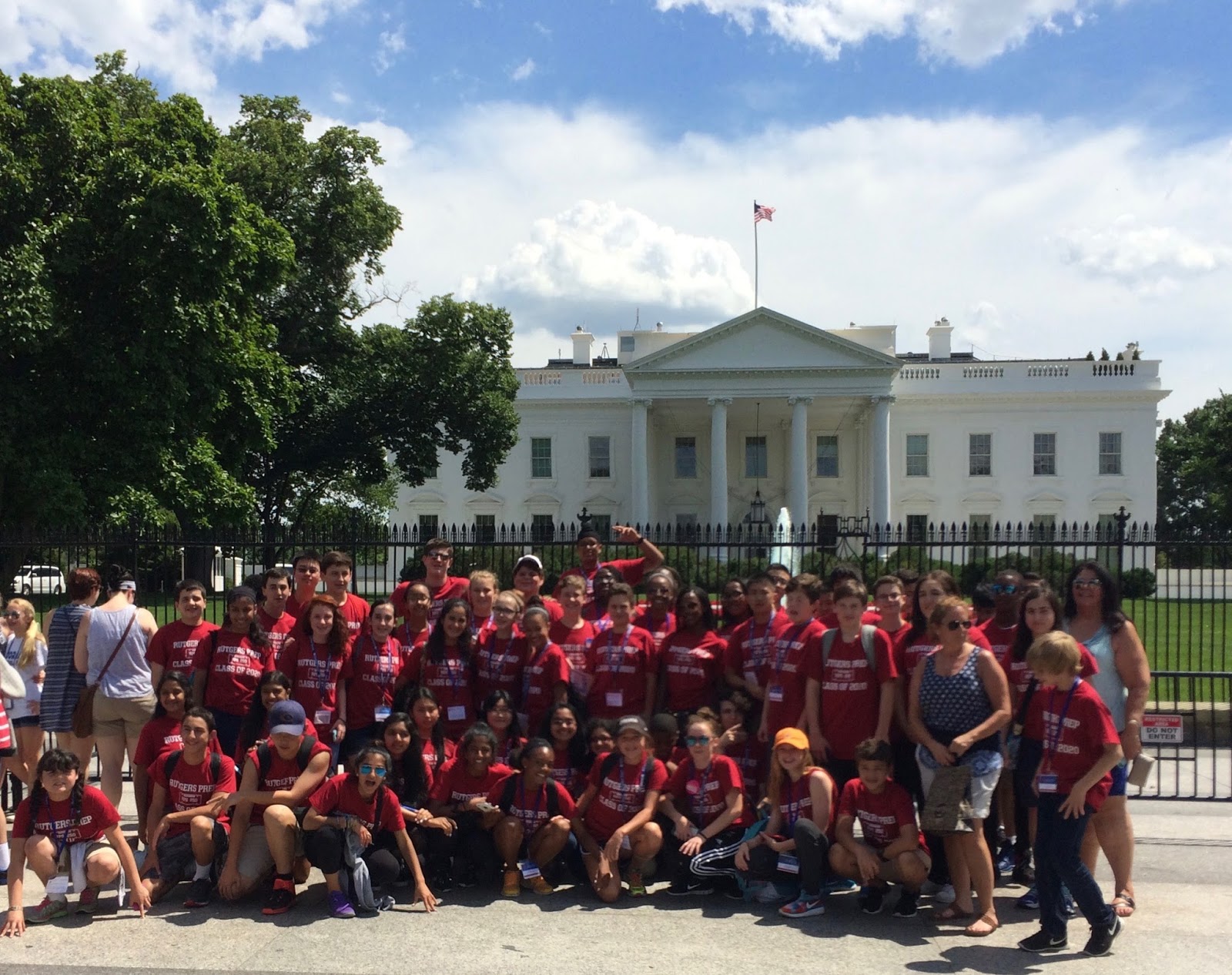
Last week, I accompanied the niblets on their 8th grade trip to Washington D.C. 


At the end of the week I proudly called their names as, one-by-one, they walked across the stage at our Middle School closing.  I have watched them go from awkward 11 and 12 year old 6th graders to much taller, deeper-voiced, and maturing 13 and 14 year old 8th graders.  The last three years have passed in the blink of an eye and now they headed off to the world of high school and years that, unbelievably, will pass even faster.  But they are enthusiastically ready for all that is coming their way, which is part of their enduring charm.

There was a catch in my throat as some of niblets walked past me to shake hands with the principal and grasp their certificate.  These kids taught me as much about myself as I taught them and I will always have a soft spot for them.  After all, they’re the niblets.


Tuesday, May 13, 2014

On Enthusiasm

Teaching Middle School after years of teaching older students has been an epiphany for me.  While it is new and the comparisons are fresh in my mind, I’m making note of some of the biggest distinctions between middle schoolers and older high schoolers.  These thoughts of mine are sometimes open-ended; I don’t have any big answers.  But I do have plenty to mentally chew upon and I intend to do so.  Today’s topic is the end of the school year.

When I began teaching 6th graders, I was charmed by their easy enthusiasm for learning.  It’s not that 11th and 12th graders aren’t enthusiastic, it’s that a teacher must earn it.  And some days, no matter how good the classroom culture is, teenagers are simply exhausted and overwhelmed.  A day like that can drag.  The end of the year is typically the most obvious example of this experience.  As the end of the school year approaches, 11th and 12th graders are school-weary.  This is especially true for 12th graders, for whom college acceptances have been received.  They really are checking out come the end of the year and it shows in class, no matter how terrific the kids are.  As a teacher, this is a challenge.

Contrast this with the 6th grade, where enthusiasm abounds.  At the start of the year, if I asked a question to get our lesson going, nearly every hand went up.  It’s the same in May, and I find their energy and boundless curiosity inspiring.  Today is our last quiz of the year and the students will begin to construct their final projects tomorrow.  They are excited about this and can’t wait to receive the assignment and get started.  That’s really the charm of middle schoolers ——— they expect that school, like much of the rest of life, should mostly be fun.  They are determined that it will be.  As I planned their final project, which places them in the position of organizing a time travel tour of history, I was aware of their mindset and kept thinking about how much fun they would find this assignment.

I think that high school can and should take a page from middle school and do more to nurse along the natural enthusiasm of kids.  Among other things, this would mean less high-pressure exams and more creative project-based writing assignments.  I know that the obvious objection is the usual canard about high school needing to prepare students for the pressure and reality of college entrance exams, college applications, and college itself.  But I think that is a poor excuse.  Learning happens most successfully at the intersection of interest and excitement.  Curiosity is a terrible thing to waste.

Saturday, April 12, 2014

Real Life Conversations at School: Bankers edition

The backstory:  My 6th graders are studying Medieval Europe and are designing their own coat of arms.  As part of that process, we learned about the symbols, colors, and themes of medieval heraldry.  This entailed exposure to some new words.

Student K:  What does fidelity mean?

Me:  It means that someone is honest, faithful, and trustworthy.

Student T:  Oh, that’s why banks use it in their names.

Student M:  Banks?  They aren’t trustworthy at all.  They shouldn’t use that word to describe themselves.

This declaration was accepted as fact by the class.  Banks, take note: the 6th grade knows what you have done and they don’t approve.


Wednesday, March 19, 2014

What Would Rousseau Say?

Teaching Middle School after years of teaching older students has been an epiphany for me.  While it is new and the comparisons are fresh in my mind, I’m making note of some of the biggest distinctions between middle schoolers and older high schoolers.  These thoughts of mine are sometimes open-ended; I don’t have any big answers.  But I do have plenty to mentally chew upon and I intend to do so.  Today’s topic is rather a big one: the nature of humanity.  

When I taught 11th and 12th graders and we learned about the formation of governments, it was first necessary to have a conversation about humans in the natural world.  Left to our own devices are we good or bad?  Selfish or selfless?  Informed by overviews of the most significant of the Enlightenment thinkers, high school students would talk through the nature of man.  These discussions were always fascinating and one of the elements that always surprised me was the confidence that 16 and 17 year olds have in the basic nature of humanity.  Teenagers often claimed that mankind is naturally good.

Among the 6th graders, as we work our heads around medieval feudalism, I’ve been having similar conversations.  I have asked them, “In a world without structure or a government to rule, how will people behave?”  Their almost universal answer: people are not naturally good and without rules to keep order, there will be trouble.  Big trouble.

It doesn’t entirely surprise me that 6th graders, kids who mostly live in a world of order and structure, believe that the rules make a difference.  One of the hallmarks of middle school is the fact that adolescents are seeking some real freedom and independence, often for the first time.  That they are receiving it on occasion invariably results in some poor decision making.  It’s not all the time, but it happens that children learning to make their way as independent young people name call, taunt one another, tattle, or otherwise seek to distinguish themselves by being unkind.  Freedom entails responsibility and 6th graders are learning their way around this rather complicated fact.

In that suddenly uncertain environment, even anxiety of the smallest kind (will I have a friendly table in the lunch room?  if I lose the cup stacking game, what will the other kids say?), can be unsettling.  Rules, structure and uniformity seems like a much safer option when faced with freedom and the occasional unkindness of humanity.

Just before break, the 6th graders and I started projects to invent our own medieval manor.  They enjoy the idea of being the lords and ladies of their own realm and they are taking care to look out for the needs of everyone in their imaginary estates.   They have seen the unkindness of the real world and are determined to mediate against it when they can.   I find this kindness heartening.  Perhaps it is this instinct that will eventually allow them to be 16 and 17 year olds who see goodness in the natural world?  


Monday, January 27, 2014

Bookworms

For me, teaching 6th graders has been an epiphany in so many ways.  As much as I hope that my students are learning their way around new ideas, I am convinced that being with them each day is teaching me even more.  On a daily basis, they remind me that school and learning is more successful when it’s fun.  Their enthusiasm spills over into virtually every element of their day and I admire that a great deal.

Case in point is their excitement about reading books.  They read their schoolbooks, of course, but many of them also come to class with a pleasure book in hand.  They crack it open when they finish a quiz early; they sneak a peak at a few lines when assignments are collected.  When asked about the stories they are reading, they bubble over with details about the tales.  They swap tips with one another, recommending books that have brought them pleasure.  I am reminded of my own book obsession at the age of 11 (to speak nothing of my continued joy in books at the age of 46).  I love the way that the 6th graders hope for quiet moments in which they can immerse themselves in a good book.

In every way, these readers offer evidence that the good old-fashioned pleasure of reading thrives as much as ever.  That’s a very happy thing.


Friday, November 08, 2013

On Grade 6

One of my regrets when I moved from teaching teenagers to teaching 6th graders was the fact that teens on the cusp of adulthood often have the self-awareness to say thank you for the ways in which a teacher has helped to make their world more manageable.  Whether it's a thank you for introducing a new idea, for writing a college recommendation letter, or for being sympathetic on a hard day, that part of the job was always quite rewarding for me.

Middle Schoolers, on the other hand, are self-absorbed.  Embracing this fact of their very existence is essential to work with them successfully and I knew that going in.  To navigate the transitions of adolescence and their growing desire to manage an independent identity, middle schoolers need patient, sympathetic adults who are not their parents.  I knew that I was up to that challenge.  Even so, I figured I would miss the less selfish elements of working with teenagers.  Sometimes, I do miss that.  More often, I am completely and utterly enamored by the 6th graders I get to teach.

They laugh easily, and often with their whole soul on display.  They expect learning to be fun and assume that new ideas are worth embracing and exploring.  They are sweetly honest.  They are incredibly eager to please adults and therefore can be re-directed with greater ease.  They are bright, poised as they are on the cusp of adolescence and teenage awareness of the world around them.  But they are still kids and will play tag or run around the playground with a joy and abandon that quite literally takes my breath away.

These have been the unexpected joys of 6th grade.  As I plan lessons for our days together, I imagine how much fun they will find a task and I get excited to share that lesson or activity with them.  It would seem that I am rather charmed by 6th graders.  And I couldn't be more thrilled to be spending my days in their company.

Wednesday, October 16, 2013

Real Life Conversations in 6th grade: Nuances edition

The backstory:  In a Middle School creative writing class, 6th graders were being reminded that their stories may feature lots of imaginary elements but no violence and no death.  Characters may be creatively removed, but it ain't gonna happen by force.  

Student J:  Ms. B, can my story have someone being chased by a chainsaw?  He won't die.

Ms. B:  No.  No chainsaw.

Student J:  Okay.  No chainsaw.  

Then he paused and tilted his head before he spoke…..

Student J:  Crowbar?

We all erupted with laughter.  Because, crowbar?  Turns out no crowbars are allowed either.

Dang it.

Wednesday, October 09, 2013

Real Life Conversation with the Sixth Grade: Ambitions edition

The backstory:  My 6th graders offer a whole new world view, as was the case in this conversation I had with student V about time management in class.

Me:  Why aren't you working on the worksheet, V?

Student V:  I'd rather do it at home.

Me:  But then you aren't doing anything in class.  You should use class time to complete class work.  Then you can review it at home.

V:  Why?

Me:  Because that's how you learn to manage your time and work effectively and because that's when I am her to help you.  One day, when you go to work, you'll need to use your work time efficiently and do your work during the work day, not at home.  We should practice now.

While V thought over this gem of wisdom, Student H chimed in with a tone of great confidence:  I don't need to worry about this because I am going to be a pop star when I grow up.


In which case, all these lessons about Roman civilization might not be all that useful.

Monday, September 23, 2013

On Grade 6

In addition to the administrative duties involved in my job as Assistant Principal, I am teaching 6th grade history.  All of our administrators teach and I love being in the classroom.  So when I first took the position, I wasn't the least bit fazed at this part of the job.   In fact, I would be hard-pressed to give up classroom time with  students, so it was essential to the switch.

In the spring, working with the other Middle School history teachers, I selected a textbook for the class.  Over the summer, I read the textbook and I thought about the topics I would teach and the skills the students need to develop.  I felt confident about the venture.  Come August, I sat down to make actual  daily lessons.  And then I panicked.  One day, as I sat in my newly-arranged office I actually thought "well, I'll just ask to go back to my usual teaching responsibilities with 11th and 12th  graders."  As if that was something that could just immediately occur at T minus one month until school began.

Instead, I took a deep breath and thought about approaching my planning on a day-by-day basis.  Lectures, discussions, and assignments of the sort you have with 16 and 17 year olds were out.  But I had a few ideas for daily lessons in mind; the book and my fellow middle school teachers had others.  I began to pull together day-by-day activities.  By the time school started, I had a plan for my first unit on the Romans……seven weeks of instruction in the bag.  A plan at least, but one bathed in uncertainty: would this work?

Within the first few days of class, it was clear that my plans were good.  What I hadn't expected was the enormous enthusiasm 10 and 11 year olds bring to the table.  In high school, you have to work pretty hard in the first few weeks to establish a rapport and get the students to take the risks to discuss big ideas.  The social context has to be overcome first; they have to trust the teacher and their classmates to really explore complicated ideas, some of which are completely new to them (looking at you, federalism).  There are periods when discussion is just a painful trudge.  Eventually, the class takes on a personality and then the learning really gets going.  Hanging over it all is the reality of material that must be covered to have the students ready for the SAT, the ACT, AP tests, and college beyond.  These are ever-looming events and the students must be prepared for them.  

But in the 6th grade, it's all out in the open.  Ask a question and every hand comes up.  They can hardly wait to share their ideas and to be heard (even on the occasionally off-topic idea).  And some of their ideas are just spot-on wise.  I hadn't quite expected such brilliance from the mouths of kids whose pencil is perpetually lost and whose binder is to large for them to get their arms around.  But it is thrilling.  It can be breath-taking to watch them think and wrestle with new ideas.  Time is immaterial; we can take as long as it takes to really understand something.  It feels luxurious, this kind of time.

Classes pass in the blink of an eye.  They laugh.  I laugh.  My mind whirls with other things we can do together.  We explore some fascinating notions and we move forward at a pace that suits all the learners in the room.  It's freedom.  And it is fun, so much fun.