Showing posts with label book report. Show all posts

Sunday, June 30, 2024

Monthly Book Report: Nightwoods

I read so many good books in June, that’s it’s nearly impossible to pick one as the monthly favorite.  I started the month finishing out the splendid The Covenant of Water and from there tore through The Lincoln Highway, Salt Houses, and Our Souls at Night.  I landed on Nightwoods by Charles Frazier toward the end of the month.  It’s the shortest of the novels on my June list but I stretched out my reading of it to savor the prose.  


I have loved each of Frazier’s novels. He writes of the South and of its people in ways that are both candid and sympathetic, never excusing their sins but always understanding their very human foibles.  His sense of place and joy in the landscape is palpable, a trait that was shared by the other novels I loved this month.  Nightwoods is the story of a young woman, Luce, and the young children she takes in after their mother - her sister - is murdered.  The children are traumatized but what they’ve seen and experienced and Luce - no stranger to trauma herself - gently cares for them.  Luce lives deep in the woods of Appalachia  in a world big in space and quiet but small in people. The people in Luce’s tiny community - an elderly neighbor and a gentle man with a crush on Luce - soon come to be the family that Luce and her niece and nephew need. 


There is suspense and tension in the novel and the characters richly drawn.  The story is told by a narrator who sees everything and though not jaded is honest, sometimes sarcastically so.  The sarcasm prevents the sweeter parts of the story from becoming cloying.  I’ve been reading library books of late but Nightwoods is a novel I purchased a few years back.  I’m glad that I own it because I will reread this story, if only to visit the splendid landscape once again.

Wednesday, January 31, 2024

Monthly Book Report: Rules of Civility

This blog is now an Amor Towles appreciation blog.   


For the second month in a row, one of Amor Towles novels is the  source of my end-of-the-month book report.  This time, it’s Towles’ first book: Rules of Civility.  Set in 1930s New York, the novel is a reflection on the rules of old wealth and the world of hard-working young women seeking a better life.  The narrators Katey, the daughter of a Russian immigrant, who is making her way up the social ladder.  Together with her friend Evelyn, Katey befriends a young man, Tinker Grey, whose wealthy status and mysterious background mask his truth.  In the course of one year, 1939, that truth reveals itself.  

The story is told at a leisurely pace, never slow but not hasty.  The reader comes to enjoy the company of Katey and her keen observations and the story is layered with mystery.  Towles’ writing shows an eye for observation and nuance.  In Katey is a narrator who tells the truth as she sees it, with a hint of sarcasm that never feels careworn or mean.  The writing is simply first-rate and I loved the novel.

Sunday, December 31, 2023

December Book Report: A Gentleman in Moscow

This book, by Amor Towles, has been on my to-read list for a long time.  When my Secret Book Santa gave it to me in a holiday gift exchange at school, it moved to the top of my list and has been my read for the last week.  


In a word, the novel is splendid.
  At turns sentimental and suspenseful, Towles weaves together a simply wonderful story of a man whose life seems limited but instead is limitless.  Pressed to make the best of a difficult situation as his beloved nation sinks into the ridiculous rigors of Bolshevism, Count Alexander Rostov remembers his father’s most valuable bits of advice: “Master one’s circumstances or be mastered by them” and “constant cheerfulness is a sign of wisdom" and puts them to good use.  With these pearls, his life —— seemingly constrained by his captivity in the Hotel Metropol —— becomes an existence of wonder, joy, and friendship.  The Count is a man the reader both likes and admires.  The novel is well-written, the narrator well-read and as charming as the Count, the Russian history at the center of the story is both well-understood and well-utilized.  It was the perfect read for me as I wait out the delay for my hip surgery and struggle to master those circumstances.  I loved the novel and will set it aside to be read again some day, grateful for the ways in which a book has once again saved me.  


Thursday, November 30, 2023

November Book Report: A Place to Hang the Moon


This gem of a book came my way via Bas Bleu, one of my favorite sources for the sorts of stories I love the most.  Set in WW2 London, it’s the story of three siblings:  Will, Edmond, and Anna.  As the novel opens, the three find themselves well and truly orphans as their elderly grandmother has passed away and there is no family remaining to care for them. Though they have resources, the lack of guardian is a problem as the oldest child, Will, is only 12.  He’s an amazing and thoughtful big brother but, like his brother and sister, he wants a family to care for him.  As the three express it, they long for parents who “think they hung the moon.” 

The family solicitor hits upon a plan of sorts: the children will join a group of evacuees departing London for the safety of the countryside.  There, he hopes, they will find a home where they may stay after the war is over.  The children are in on the plan, though it’s being kept secret from everyone else, and they set off with a group of evacuees.  The first home in which they are placed shows promise - the parents are kind -  - but the brothers in the home are not welcoming.  Relations are tense and then an incident sets up conflict and the children are forced to seek another host.  The second home is no improvement at all and is even worse in many ways: the children are cold and hungry.  Comfort of sorts is found in the routines of school and actual happiness can be found at the town library, where the librarian, Mrs. Muller, proves to be welcoming and kind.  Each day after school, the children visit the library to read and find solace in books.  Privately, the children wish to ask Mrs. Muller to host them and Mrs. Muller seems willing……and well, I don’t want to ruin it for those of you who like a good story.  This one is splendid.  

It’s all set up for just the sort of happy ending I love best.  The story is well-written (the narrator is terrific) and the children are both wise beyond their years but still very much children.  I loved this book and it will live happily on the re-read shelves at my home.  

Saturday, September 30, 2023

Monthly Book Report: Delicious! by Ruth Reichl


Like every other cook in the world, I have read a good deal about Ruth Reichl and here and there, I’ve read Reichl herself, in Gourmet and elsewhere.  I’ve enjoyed her humor and joy in the day-to-day and I’ve always admired her appreciation of a well-cooked meal.  I picked up Delicious! from the library and it was a fun read as I transitioned from summer into the start of school.  

It’s the story of a young woman, Billie, who lands a dream job at Delicious magazine in NYC.  Just as Billie is settling into this quirky workplace, the magazine suddenly shuts down.  The rest of the novel is devoted to Billie finding her way forward, solving a mystery in the letter archives at Delicious and finding her self along the way.  

The story was filled with quirky - but believable - characters and I could feel the happy ending that I always enjoy in a book.  I worried that the recipes and food would be too much for me to enjoy as I am trying to lose weight so I can have a hip replacement, but that turned out not to be the case.  It was a happy little read and I’ll be back for more of Reichl’s work.

Thursday, August 31, 2023

Monthly Book Report: Above Ground by Clint Smith

I became a Clint Smith fan reading his work in The Atlantic.  Then I picked up his book How the Word is Passed and my admiration grew exponentially.  Smith’s work is thoughtful, deeply engaged with history, personal without being cloying, amused by the human condition but also deeply honest about where racism has landed us as a nation.  I persuaded my book group to read How the Word is Passed.  I assigned chapters of it to my 8th graders and it generated the most amazing conversations.  So of course I was going to read his new book of poems.  


As expected, Smith doesn’t disappoint.
  In this collection about being a father and husband, as he reflects on family and the things he loves most - soccer, his wife, his children - I was utterly charmed.  

I am worried that this nation is on the precipice of a spectacular failure of community and democracy.  But when Smith reflects on waiting for a heartbeat to emerge in his wife’s early pregnancy and writes, 


little one

you are my daily reminder


that you do not go to a garden to watch 

the flowers grow


you go to give thanks

for what has already bloomed


Well, that takes my breath away and gives me a tiny sliver of enduring hope for us all.  

Monday, July 31, 2023

Monthly Book Report: American Wife by Curtis Sittenfeld


I have had this book on my to-be-read list forever and when I spied it at the Library a few weeks back, I impulsively brought it home.  I am so glad that I finally sat down to read it.  Though I’ve read her essays and heard her on "This American Life" on many occasions, I’ve never read any of Sittenfeld’s fiction.  Based on this book, I’ll be back for more. 

American Wife is the story of Alice, a middle class young woman from Wisconsin who marries the son of a political family and finds herself thrust in the limelight of American politics.  Alice is not naive when she meets Charlie Blackwell - quite the reverse.  She’s single and in her early 30s, happy with her life as a librarian, not sure if she’ll ever fall in love, and not willing to settle into a relationship without love just to be a married woman.  Given that the title of the novel includes the word “wife”, the reader knows how things will work out for Alice and Charlie, so I was surprised I found the story so powerful.  

It’s in Alice’s thoughts about her life before her marriage that the novel really spoke to me.  Though she is in her early 30s when she and Charlie meet, and I am in my mid-50s, I could see myself in Alice’s fulfilling life as a single woman.  As I sort out my life here, in this space that I never expected to be, I’ve found enormous satisfaction in my ability to be true to what I want and what I need.  It feels like a really long time since I have been able to do that.  I find comfort in this place, both because it is comfortable and because I think that’s where life will land me in the end.  I am not the sort of person too long for an outcome that is not likely to be available to me.  It’s not always easy - most of my friendships are with people who are comfortably (and, I think, happily) married.  I’m often the only single woman in a group of people.  That can be really hard.  I especially miss a companion with whom I can talk about the small concerns of my world; in that circumstance is where I experience my greatest sense of being solitary.  

In the novel, there’s a scene early in her relationship with Charlie when they are at the grocery store in line to buy food for a meal they will make together and a now-coupled Alice sees her single self in the woman behind her in line.  She’s glad to be with Charlie but not in a way that makes her feel sorry for the single woman.  Instead, Sittenfeld’s Alice thinks, “It’s good on the other side, but it’s good on your side, too.  Enjoy it there. The loneliness is harder, and the loneliness is the biggest part; but some things are easier.” 

For a generally outgoing and bold person, I’m surprisingly private in other ways, so I am rarely lonely.  But I knew what Alice meant.  When you aren’t part of a couple you have a protective shell of sorts; you have to or your sense of vulnerability could overwhelm you.  It’s not loneliness, per se, but it can feel lonely.  The compensation is that there is also plenty of space to be true to yourself in a way that is an incredible comfort.  I think that Alice understood that and I liked her very much for it.

Friday, June 30, 2023

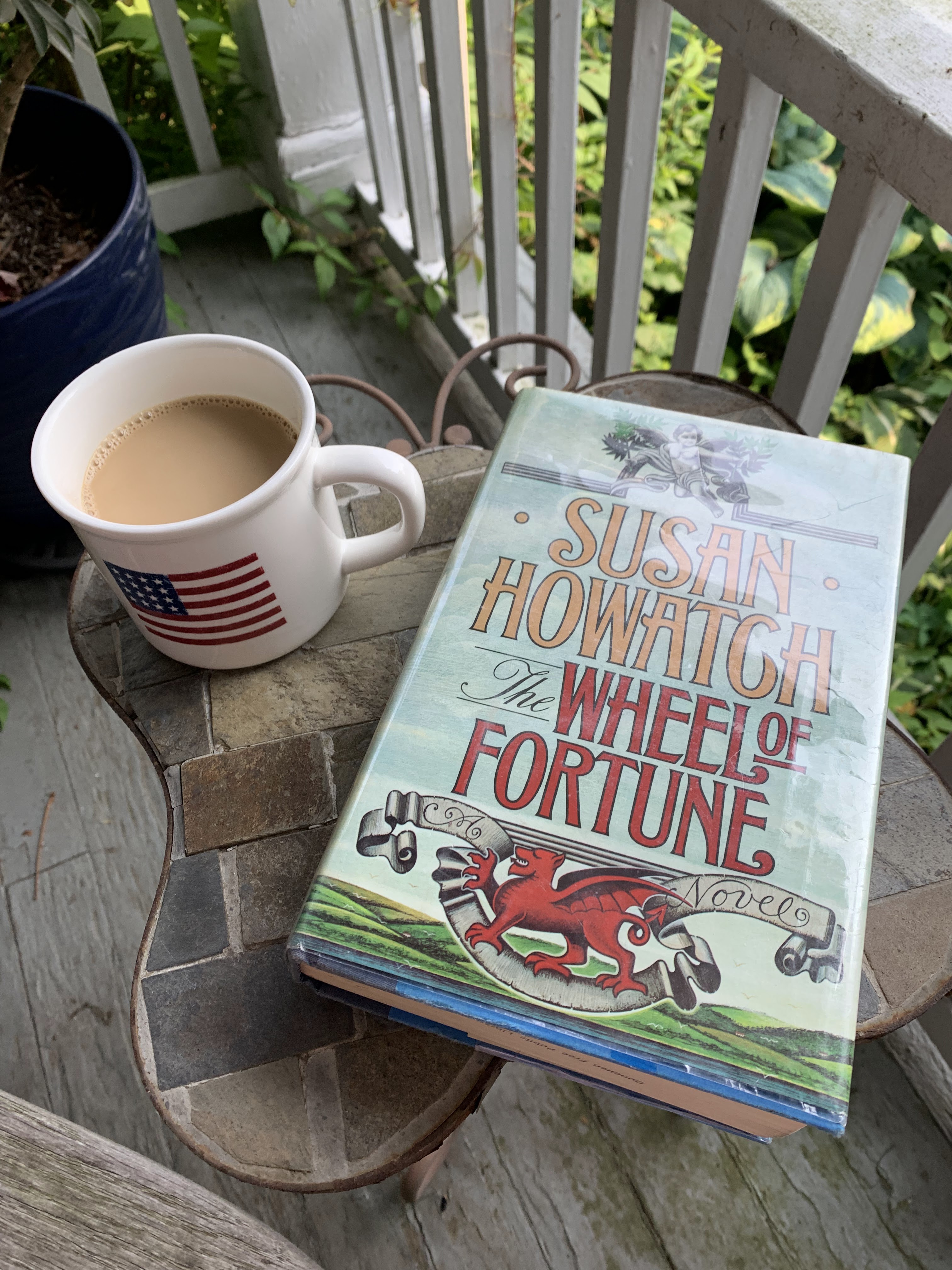
Monthly Book Report: Wheel of Fortune


For most of my adolescence, I loved to read historical fiction.  I consumed books about Eleanor of Aquitaine and Queen Elizabeth and read the entirety of the historical biography section in the school library.  I read other books as well but books set in another place and time were my personal sweet spot.  Weirdly, I did not enjoy history in school, where the subject was most often boring and crusty; taught be a series of teachers who were the same.  Only in books was history splendid.   In college, I discovered that academic history could be amazing; soon after that I became a History and Political Science double major. 

The subject of this month’s book report - all 980 pages of it - is historical fiction.  The story begins  in the late 1800s.  the story of a family - the Godwins - and their Welsh estate, Oxmoon.  Loosely based on the real-life story of The Black Prince and his wife, Joan of Kent, the novel is utterly compelling. I had read the novel before - back in the 1980s when it was originally published - and all I could remember was that I loved it.  When I saw it on the shelf at my local library, I grabbed it right up.

Told in six sections, each narrated by a different member of the Godwin family, the story moves from the 1880s to the 1960s.  Each narrator explains their version of the events unfolding and they layer on information about events that have already happened.  The result is a rich and compelling story about one family, but they are people who stand in for families everywhere, with their truths, those that matter in the long run as well as those that don’t.   Howatch writes beautifully and richly.  The leisurely pace of the story matched the relaxed pace of Summer for me.  I have hours to read and the novel offered hours of reading…that is my perfect (and happy!) sweet spot.  

Sunday, April 30, 2023

April Book Report: Mrs Harris Goes to Paris


Earlier this month, I went by the town library and got myself a library card.  When I was growing up, libraries were magical places and everything about them was thrilling.  Filled with the prospect of nearly endless books that I hadn’t yet read, I loved them as a girl.  As a grew up, libraries became places to study and get school work done and I loved them for that.  As a parent, JT and I visited the school library and delighted in a new stack of books to bring home.  It’s been several years since I had a little boy to take to the library but the recent news about book bans and libraries and librarians under attack reminded me of the magic I used to find in libraries.  So I looked up the hours and went to my local library.  

I am best-pleased to report that it is as delightful and happy as the libraries of my girlhood.  I came away with a stack of books and a newfound pleasure in the prospects to be found in this local treasure trove.  

This month’s book report is about a book I found at the local library, a two-volume book by Paul Gallico:  Mrs Harris Goes to Paris & Mrs Harris Goes to New York.  Written in 1958 (and turned into a film last year), the book is about the adventures of an industrious char lady from London.  Mrs Harris, a woman in her 60s, works hard cleaning the homes and tidying up on behalf of posh clients.  She’s been doing so long enough that Mrs Harris may choose her clients and lives a happy, if tiring, life in London.  It’s while she’s cleaning up after Lady Dant that Mrs Harris first sees - and touches - Lady Dant’s beautiful Dior dress.  Mrs Harris is charmed - besotted, really - and the novel is all about the char lady’s effort to acquire her very own Dior dress.  First, she scrimps and saves and finally she sets off to Paris to acquire the gown.  

The novel was a lovely and quick read, funny and clever and the sort of cheering story I love best.  A happy ending is virtually guaranteed from the first page of the novel and the adventure is in the twists and turns that unfold on the way to the inevitable happy conclusion.  Just my sort of book, always, but especially this month which has found me in need of good cheer.  Thanks to the local library (and Mrs Harris!), I found just that.  That's a blessing that will last, I expect and I am grateful for it.

Friday, March 31, 2023

Monthly Book Report: Emma, by Jane Austen


There is a new book group among some of the women in my family and our first read was Emma.  I’ve read Emma before - on many occasions actually - and I am always down with the classics, so I happily picked up Emma and, as expected, it proved a lovely read for the month. 

Emma is not my favorite Austen novel but I enjoyed this reading a great deal.  For starters, the characters - like all Austen books - are well-drawn and amusing.  The narrator is an honest broker with a keen observation skills and a sarcastic sense of humor, also a durable feature of many an Austen novel.  In the case of Emma, the narrator is nearly a character of her own and is a big part of the pleasure I get from reading the novel.

Emma herself is not the most sympathetic of Austen heroines but I even like that about her.  She’s well-off and snobbish and Austen - and Emma herself - makes no apologies for that.  Emma is happy in her world, circumspect though it is, and I admire that about her.  Austen’s writings are deeply invested in the lives of the women.  They live in the early 19th century and I am always struck by the ways in which meaning for women is relational - not about who they are for themselves but about whom they are for others.  I’d like to think that in the 21st century, we are past this view of women.  Experience tells me that we are not  and that makes this 200 year old novel a rather timely read.

Tuesday, February 28, 2023

February Book Report: In Praise of Miss Read

On the first day of this month, I woke up early and as I lay in the darkness I remembered to say “white rabbit, white rabbit” before I got out of bed.  I won’t say that I expected good luck to join me for the month, though I did hope as much.  Alas, that is not how the day played out.

Most of my plans for February were set aside so that I could fly West and spend time with my family, and especially take time with my mom.  To look after my own heart, I turned to my favorite Miss Read books, Changes in Fairacre and Thrush Green.  These series are beloved favorites for me, stories that I have read again and again.  I find friendship and familiarity in the lives of the characters who live in these imaginary places.  


Changes in Fairacre takes place just past the midpoint of the Fairacre series and is full of reminders about the comforts still to be found amidst the fragility of life.  As Miss Read settles into the cottage she has inherited after the death of her dear friend Dolly Clare, she remembers her with a sweet fondness, and determines to move forward to enjoy life.  It was a message that was especially timely for me this month.

Thrush Green is the first of the Thrush Green series and I first read it in the Summer of 2006, a very hard time for me.  That year, the book was a great comfort.  When I reread it now, it’s both a comfort and a reminder of how strong I can be when the need arises.

These familiar novels were the backbone of my reading this month.  They were both companion and comfort as I thought about my Dad and the fragility of life.  Being strong when it’s called for is my superpower.  In my favorite books, I find the strength that I need to see me through the hard parts of life.

Tuesday, January 31, 2023

January Book Report: Invisible Child by Andrea Elliot

 I read Invisible Child for the faculty book club at school.  I knew of the story from having read some of it in the New York Times, where Elliot worked as a reporter and first conceived of the story.


The book follows the life of a girl named Dasani, born in 2001, and 8 years old and living with her family in a homeless shelter in Brooklyn when the story begins.
  We follow Dasani, her parents, and her seven siblings for 10 years.  Elliot’s account is both compassionate toward Dasani and her family and condemning of the discordant and failing maze of social services for homeless families in NYC and, I suspect, the nation.

Dasani and her family are Black and that clearly has an affect on them.  They are homeless and often hungry.  They rely on a social services network that is painfully bureaucratic even while it spends millions of dollars each year without securing safe housing for children and families.  There are more than 75,000 homeless children enrolled in NYC public schools and Elliot’s account of the schools - especially McKinney Middle School in Brooklyn - reveals that these institutions are staffed by teachers and administrators who truly care but who are also trying to provide  education as a balm and solution amidst a torrent of disasters that befall poor children.  It’s too great a task in far too many cases.

 Elliot’s account of ACS and NYC social services is less compassionate.  Though sometimes staffed by people who genuinely care they are just as likely to be overwhelmed by rules and bureaucracy.  Services and care are often dismal as a result.  Since we are talking about children and families, dismal is a disaster. 

At one point, Dasani and her siblings are in foster care - separated from their parents and one another - at a cost in excess of nearly $50,000 a month.  That kind of money would - of course - be better spent housing, clothing, and feeding the family than it would be balkanizing them.  The separation is disastrous for many of the children, not to mention their parents.  The children who do survive it, do so with social and emotional wounds that may haunt them for the rest of their lives.  The best outcome is for a member of the family to be limping along but never thriving.

It is well-known that I prefer a happy book.  This story is not happy.  But it was utterly compelling and revealed a family that had complicated needs and problems but always - always - had love.  In that, there is happiness of a sort.  Love is clearly not enough but it is a start and a social services network that keeps that knowledge at its core might be able to truly help.  It should never be acceptable in this rich nation for a child to be hungry or homeless.  The problems that result from that are assuredly complex.  But, as Elliot thoughtfully demonstrates, the cure need not be worse than the condition itself.  

Sunday, February 28, 2021

February Book Report: All the Light We Cannot See

I have had this book on my to-be-read list for quite some time because it is the sort of book that ticks all my boxes: about Europe in WWI, with two young people at the core of the story, a narrative told by an omniscient narrator…..all the things I am bound to love in a book.  


I am the sort of person who saves a good book for just the moment that I need it and as our February opened with vast amount of snow while T and I finished out our quarantine, I picked up All the Light We Cannot Seeby Anthony Doerr.


The book did not disappoint, which is a gross understatement because this book is simply splendid.  The story unfolds gradually at the start of WWII and is mainly told from the point of view of Marie-Laure, a blind girl living in Paris with her father and Werner, an orphan in Germany who will be given an education and then opportunity by the Third Reich, things that he comes to recognize as the double-edged sword they are.  


That the two will come to know one another is clear from nearly the outset of the novel and as Doerr weaves together to story of that meeting, there are beautiful reflections on the nature of love and responsibility, the meaning of the lives regular people live, and the power of a story and sound to lend meaning and vitality to our lives.  To me, a voracious reader and radio-listener, there was such familiarity in those things.  


Doerr can turn a phrase and he won’t be hurried,  two of the very best things about the novel.  He doesn't underplay the horror of war, but reminds us of our humanity amidst it.  I’ve only read the book once but I know that will come back to this novel again and again, to savor the story and Doerr’s reflections on the human condition.  I finished it a few weeks ago but I am still savoring it.  This is the highest complement I can pay a book and I pay it gladly!

Sunday, January 31, 2021

Book Report: Miss Read in January

 For 2021, I decided to take up a monthly read of two Miss Read Books:  Village Diary and The Year at Thrush Green.  I’ve read both of these books many (man!) times before; they are familiar and happy favorites in my world.  Both books have a chapter for each month of the year and I plan to read the chapter corresponding to the month at hand, progressing through the stories month-by-month.


Village Diary might very well be my favorite of all the Miss Read books, which is saying something.
  In it, the character of Miss Read is unvarnished, with her sarcasm on fine display in a way that I especially enjoy.  Both books are written as monthly diaries and so they make a nice seasonal companion for the year.  The imaginary towns of Fair Acre and Thrush Green had cold and snowy Januaries and by all accounts we’re to close out this month with a humdinger of a storm - the forecast calls for more than 20 inches in my corner of the state - so the chapters were an especially fitting close to this eventful month.  I always enjoy a little time in Miss Read’s world and this 2021 project is a happy one to contemplate.

Thursday, December 31, 2020

December Book Report: Christmas Stories

When I was truly able to settle into Winter Break, I pulled out three holiday books to read.  Two of them, the books by Miss Read and Alice Taylor, are long-standing holiday favorites.  Reading them is a tradition that I look forward to and always enjoy.  The third, a mystery by Georgette Heyer, was new to me.  I read them all at once for the days before Christmas and they were a happy pause from the real world. 


Books are my comfort and joy in all times and that has especially been the case in this difficult year when there was extra time to read even as I had a greater need than usual to be comforted by good stories.
  I am always grateful for the power of the written word and this year that was especially true.

Wednesday, September 30, 2020

September Book Report: No Ordinary Time

All summer long, in preparation to once again teach 20th century history, I read (and re-read) books about the last century  One of the very best re-reads was Doris Kearns Goodwin’s 1994 Pulitizer Prize winning history, No Ordinary Time, about Franklin and Eleanor Roosevelt and the Home Front in WWII.  

The book is carefully researched and thorough; the context of the Roosevelt story is present as the narrative flows well and the reader is never in doubt as to the challenges of the period.  Neither is there doubt about the power of good, capable, strong, measured, and steadfast leadership.  Though the 1940s did not receive (or demand) the transparency that Americans now need in their leaders, neither was the secrecy of the era about deception or a cover for the ignorant and selfish cowardice that I see and hear so often from our current president and his political allies.  


If anything, Franklin Roosevelt took care to provide Americans with the truth always accompanied with a sense that together we could accomplish great things, not just for one another but also for the world.  I miss that sense that our national purpose must be greater than ourselves.  


In the very last speech that he wrote, in April of 1945, as the war in Europe was coming to a close, Roosevelt wrote words reminiscent of his oft-quoted, 1933 reminder that “we have nothing to fear but fear itself.”  This time writing, “The only limit to our realization of tomorrow will be our doubts of today. Let us move forward with strong and active faith,”  the president set the stage for the post-war challenges he knew his nation would face.  Roosevelt would never deliver the words in the form of speech because he died later in the day that he wrote them.  But the words are a solace and comfort today.  


I’ve read these words before but in early September, as I was ginning up for the start of a hybrid teaching school year and watching the events of our coming November election with anxiety-tinged hope, I thought again about our need to face fear and doubts with active faith.  The words have provided comfort throughout this month and, I suspect, they will give me hope for the rest of this crazy year. 

Friday, July 31, 2020

July Book Report: Mrs. Griffin Sends Her Love


I first discovered Miss Read books in 2006, a very hard year in my life.  I saw a description of two Miss Read books in the Bas Bleu book catalog and took a chance on these two stories —- the first two books in the Thrush Green series, published in 1959 and 1961, respectively .


I loved the books at once and was best pleased (to use a Miss Read phrase) to discover that there were many more to be read, both in the Thrush Green collection and also a whole other series about a town on the English Downs named Fairacre.


These books and the stories within them were both my salvation in that year and a source of great joy to me since I first read them.  In theory, books set in mid-20th century rural England had almost nothing in common with my life as a 21st century single mama living in the the suburbs.  In fact, they proved timeless and reminded me to enjoy the small pleasures in life - a cup of tea, the vexing pleasure of abundant garden produce, the chirp of the birds on a Spring morning, the day in February when there is still a bit of sunlight to be had after 5 pm, the couch of Fall leaves on a cool morning, the first blooms of the coming Spring….really the list is endless.


Dora Saint, the writer behind the Miss Read books, passed away in 2012, at the age of 101.  This means that though her stories live on (and are among my favorite re-reads), there are no new works to be sought. Or that was the case until recently, when Orion Publishing released a collection of essays and small compositions that were the first Dora Saint works; all bits published in English newspapers and magazines that weren’t published in the United States.


New Miss Read! 


I bought a copy straight away and set it in my to-be-read pile with a great deal of excitement.  The book has light editing and commentary by Dora Saint’s daughter, Jill Saint, and re-productions of many of the illustrations from the original Miss Read books.  


At just over 300 pages, it was a splendid treat to spy in my book pile as the worst days of the pandemic raged on here in my corner of the world.  I read the introduction and back cover endlessly, but I saved the book itself to read after school was out.  Though I am typically the sort of voracious reader who gobbles up a good book in just a few days, I treated myself to just a little bit each day, so as to enjoy my treat just a little bit longer.


The volume ends with some classroom vignettes from the early drafting of the Fair Acre books.  Though Miss Read preferred the stories of her Thrush Green books (a fact I discovered in this volume),  the Fair Acre stories are my favorites.  Written in first person by the schoolteacher herself, whom Saint describes as a woman who, “…was born fully clothed in sensible garments and aged about forty,” they connect with me in ways too numerous to explain.


Ahhh, Miss Read.  Always practical and with a sentimental heart that never turns maudlin, she loves her students for the children they are, with practical affection and a tolerant patience that I both admire and seek to achieve.  This collection was a balm for my anxieties and a reminder of the joy to be found in the simple pleasures of life, like a good book to be read on the front porch come some happy Summer morning.

Tuesday, June 30, 2020

June Book Report: The Warmth of Other Suns


This month, I re-read Isabel Wilkerson’s splendid The Warmth of Other Suns: The Epic Story of America’s Great Migration.  I first read the book when it was published in 2010 and the stories and history Wilkerson wove quickly inserted themselves into both my understanding of our national history and my teaching of it.  I never forgot the descriptions of the journeys that Wilkerson describes and when I began to plan the Civics and Citizenship class I will teach 8th graders in the coming school year, I knew that Wilkerson’s book would be a part of it.


At over 500 pages, it’s rather more than the 8th grade is ready for all at once.  But earlier this month I commenced a re-read to choose sections from the book to serve as the foundation for the summer reading I will assign the class.  In any setting, the book is worth reading.  In this moment of historical time, as the growing Black Lives Matter has absorbed our national interest to a greater degree than it ever has before, it was a particularly powerful re-read.


Wilkerson writes like a journalist but thinks like an historian and the combination ensures that the reader flies through the pages.  When I did put the book down, my mind was consumed with the arc of the story she was telling.


My Civics and Citizenship class will start with the second founding of the United States, the one accompanied by the Reconstruction amendments.  Though the Great Migration doesn’t “officially” start until the second decade of the 1900s, the seeds of it were planted by those amendments and our subsequent national failure at the task of rebuilding a national union with liberty and justice for all.  My class will take itself to the 1970s and the close of the Great Migration.  At every stop along the way, Wilkerson’s book will accompany the story we will learn.


Parts of the book will be required reading for my 8th graders.  I do this in the explicit hope that as they grow into their citizenship, they will read the rest of the book on their own.  


Sunday, May 31, 2020

May Book Report: Florida


Florida is the first Lauren Groff book I have read.  It won’t be the last.  The book is a collection of short stories linked together by, fittingly, by the idea of the state.  Florida - the weird, oddball Florida that makes the state its own Fark category - is at the center of it all.


I am no fan of Florida the state but I do love the South and I always enjoy a story with a strong sense of place.  The further north you travel in Florida the more Southern the state is and Groff clearly knows this truth.  Florida, its teaming plants, its steamy, thick air, and its oddball ways are the character that is consistent across all of the these stories in this gem of a collection.


The stories are more descriptions of events in time and space than they are traditional narratives.  The characters who exist are well-developed, not always likeable but Groff is sympathetic to them and their humanity and, consequently,  so is the reader.


I am not usually a fan of short stories, though some of my favorite authors (Pam Houston and Bailey White come to mind) are short-story writers so maybe I am just particular about short stories.  Groff’s collection will go on that list of likes.  Like Houston and White, she can turn a beautiful phrase and there are dozens in this collection:


“…I decided that if I had to live in the South, with its boiled peanuts and its Spanish moss dangling like armpit hair, at least I wouldn’t barricade myself with my whiteness in a gated community.  Isn’t  it…dicey? people our parents’ age would say, grimacing, when we told them where we lived, and it took all my willpower not to say, Do you mean black, or just poor?”


“On my nighttime walks, the neighbors’ lives reveal themselves, the lit windows domestic aquariums.”


To describe an incommunicative father and his leery son , Groff writes, “language wilted between them.”


Of a women remembering fragments of poems, she writes of “a strange, sad poem, Blake and Dickinson and Frost and Milton and Sexton, a tag-sale poem in clammy meter…”


Florida itself is in the language of this book’s dangling Spanish moss, aquariums; wilted, clammy, and thickly humid.


There are 11 stories in Florida  and I treated myself to one each morning over the last days of May, as the weather finally warmed up enough to be comfortable out on the front porch in the early morning.  I consumed them with my morning coffee and each made a companion for my busy days.  When I lay my head down at the end of each full day, the thought of a new Groff story come the morning passed through my weary mind.  It was - and is - something good to anticipate.