This book, by Amor Towles, has been on my to-read list for a long time. When my Secret Book Santa gave it to me in a holiday gift exchange at school, it moved to the top of my list and has been my read for the last week.

This book, by Amor Towles, has been on my to-read list for a long time. When my Secret Book Santa gave it to me in a holiday gift exchange at school, it moved to the top of my list and has been my read for the last week.
I became a Clint Smith fan reading his work in The Atlantic. Then I picked up his book How the Word is Passed and my admiration grew exponentially. Smith’s work is thoughtful, deeply engaged with history, personal without being cloying, amused by the human condition but also deeply honest about where racism has landed us as a nation. I persuaded my book group to read How the Word is Passed. I assigned chapters of it to my 8th graders and it generated the most amazing conversations. So of course I was going to read his new book of poems.

I am worried that this nation is on the precipice of a spectacular failure of community and democracy. But when Smith reflects on waiting for a heartbeat to emerge in his wife’s early pregnancy and writes,
little one
you are my daily reminder
that you do not go to a garden to watch
the flowers grow
you go to give thanks
for what has already bloomed
Well, that takes my breath away and gives me a tiny sliver of enduring hope for us all.
When I became a single mama who had to turn over her beloved child to his other mother for a weekly vacation with her in the Summer, I knew enough to understand that a weekend without him was one thing but that a week would stretch far too long. So I began to sign up for teacher’s workshops. They’d last 5 days or so and I could be there and focus on myself, learning and meeting new people, and not needing to complete mama chores. It was freeing in a way: I was having fun and he was having fun and that was important since we weren’t able to be together. Usually, the classes were small - 20-30 people - and the group developed a camaraderie as we navigated the class and shared lesson ideas. I have fond memories of workshops on Mark Twain, George Washington, and an amazing Civics class taught by Sandra Day O’Conner.
When T and I parted ways last November, I turned to this tried-and-true formula to fuel an adventure about me. I signed up for a class. I’ve just finished the class and - as expected - the history was great. But the camaraderie was not as expected. For starters, there were 7 workshops, each with nearly 50 participants, more than 350 teachers in total. We sat in lecture halls, not around seminar rooms, and so there was a lot more listening than sharing. I love a lecture but it doesn’t build much community (side note: that is for sure a teaching lesson I will remember). Many people came with teachers from their district or school and so their social network was already set up. I met people but I would not say that I bonded with anyone. It was a teacher crowd and so there was a whole lot of husband and partner talk and that often makes me feel a little left out, for obvious reasons. By the end of the week, I grew weary of having to ask to join a table and so on the last night, I took my supper to a table in the outdoor shade and read my book. There wasn’t a lot of evening hanging out so I took walks and spent some time reading Cup of Jo comments, which provided a welcome sense of community. I am proud of myself for going to the class and taking the risk. My mind is whirling with the things I learned and the lessons I will construct on the other side. Going to the workshop alone was a trial run to see if I am up for single-gal travel and I think that I learned that I am.
For most of my life, I’ve been the sort of person who reads the Declaration of Independence and gets teary-eyed at the ideas expressed by the preamble. I’m aware that the founders fell far short of the notions being embraced; I know very well our history of slavery and vast inequality. Still, the words - and their promise - have rung true to me as powerful aspirations that represent what the United States can become.
My belief in the words of the Declaration have made the last few years especially difficult. A great deal of the problem seems to lie with the Supreme Court and their 2022 decision to cast aside 50 years of precedent and declare that bodily privacy was no longer protected by the Constitution. It’s true that the Constitution did not explicitly declare body privacy. It was document written in the 18th century, when such a notion did not exist. But it’s equally clear that a group of men who would not house soldiers in their private property or permit a search of their homes without sworn warrants clearly understood the notion that a home was private. The human body is the penultimate of home. It houses our soul; the very core of our being. That body should not be regulated by the government with no limits; it cannot be invaded. It took women more than 140 years to gain the right to vote and that struggle is symptomatic of all that women endure in our aspiration for equality. Last year’s invalidation of the right to bodily privacy for women, a ruling that effectively denies certain kinds of medical care to half of the nation, is clearly a decision that puts men squarely back in the driver’s seat when it comes to women’s bodies. It’s inexcusable. I’ve spent the last year frustrated and angry, wondering what other rights marginalized groups might lose.
Last week provided the answer. On Thursday, a majority of the justices of the Supreme Court struck down affirmative action, the 50 year old effort by America’s colleges to correct some of the inequities and injustices wrought by our history of racism and exclusion. That the majority opinion used the 14th Amendment’s guarantee of equal protection under the law to do so is especially appalling. The 14th Amendment is one of three post-Civil War Amendments to the Constitution. The 14th made former enslaved people into American citizens due the “equal protection of the law.” It was added to the Constitution in 1868 but for many years equal protection was merely an unfulfilled promise, as Jim Crow laws and legal, social, and political inequality continued apace. Not until 1954’s Brown v. Board of Education ruling was equal protection under the law applied to Black school children. That opened the door to end the most aggressive forms of de jure inequality and segregation. But de facto inequality continued apace. Affirmative action began to be used in the late 1960s to ensure that historically excluded groups had the opportunity to have a seat at the table of power. It benefitted white women more than it helped people of color and was an imperfect remedy to a nation whose original sin was the protection of slavery while claiming rights to liberty and equality it would not extend to everyone. In her dissent to the ruling which invalidated affirmative action, Justice Kentanji Brown-Jackson said it best, “With let-them-eat-care obliviousness, today, the majority pulls the ripcord and announces “colorblindness for all” by legal fiat. But deeming race irrelevant in law does not make it so in life.”
A day later. the majority on the Supreme Court declared that business owners could discriminate against gay customers because of the business owner’s religious views. This ruling turns a blind eye to state or federal laws which enshrine equal protection under the law as some state governments and the federal government seek to prevent overt discrimination against gay, lesbian, or trans Americans. Coming as it did after the rulings on the right to privacy and affirmative action, it was no surprise.
But that doesn’t mean it’s not a sucker punch…it is, especially in the midst of so many states bent on limiting the rights of trans people to freely live their truth. It also makes it hard for me to get emotional or teary-eyed about the 4th of July and celebrations of independence. Until we recognize that each and every one of us are created equal and are entitled to life, liberty, and the pursuit of happiness, none of us can truly be free. That painful truth is evident every day, but especially today as we celebrate a national independence that is yet incomplete.
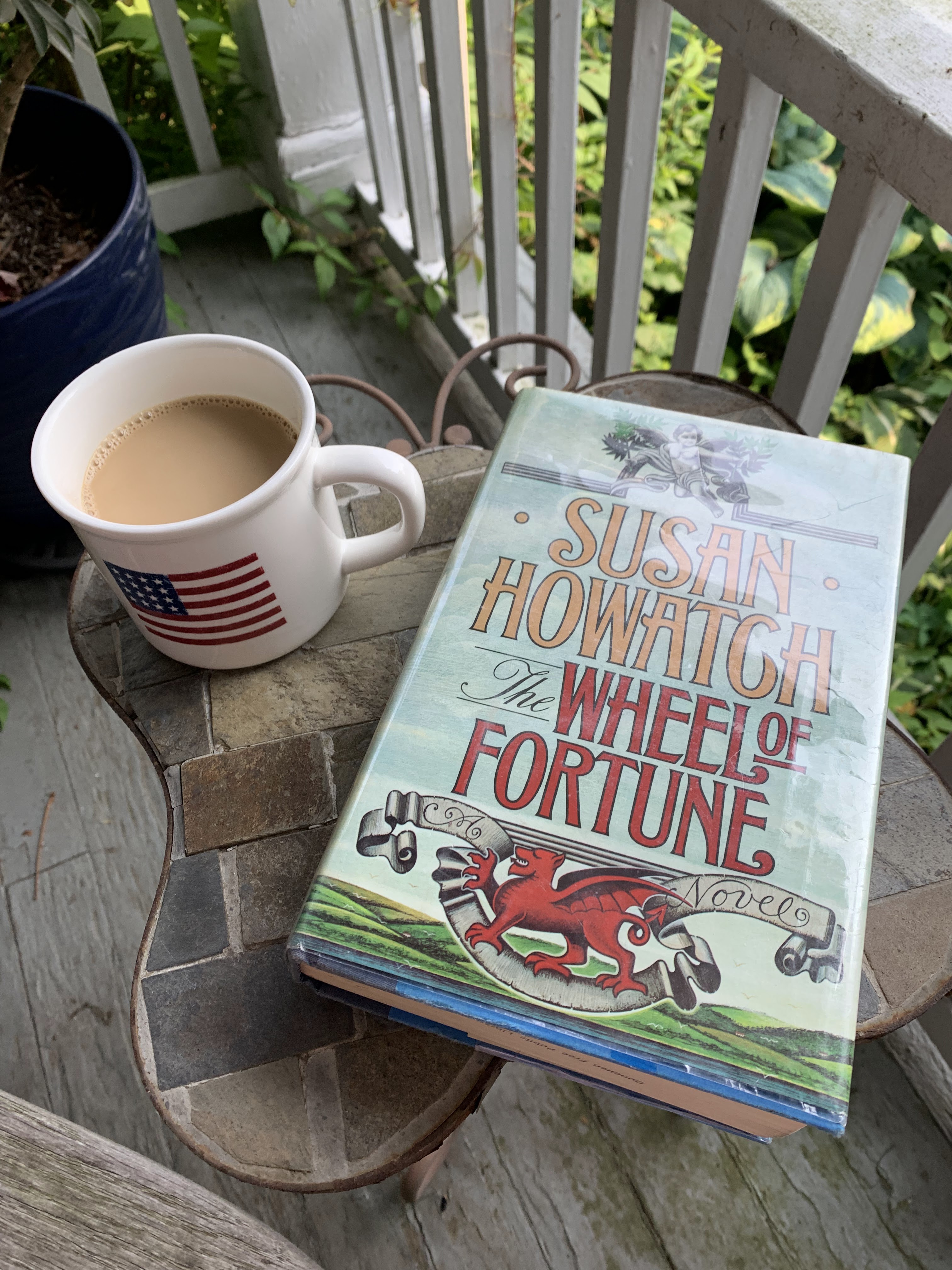
For most of my adolescence, I loved to read historical fiction. I consumed books about Eleanor of Aquitaine and Queen Elizabeth and read the entirety of the historical biography section in the school library. I read other books as well but books set in another place and time were my personal sweet spot. Weirdly, I did not enjoy history in school, where the subject was most often boring and crusty; taught be a series of teachers who were the same. Only in books was history splendid. In college, I discovered that academic history could be amazing; soon after that I became a History and Political Science double major.
The subject of this month’s book report - all 980 pages of it - is historical fiction. The story begins in the late 1800s. the story of a family - the Godwins - and their Welsh estate, Oxmoon. Loosely based on the real-life story of The Black Prince and his wife, Joan of Kent, the novel is utterly compelling. I had read the novel before - back in the 1980s when it was originally published - and all I could remember was that I loved it. When I saw it on the shelf at my local library, I grabbed it right up.
Told in six sections, each narrated by a different member of the Godwin family, the story moves from the 1880s to the 1960s. Each narrator explains their version of the events unfolding and they layer on information about events that have already happened. The result is a rich and compelling story about one family, but they are people who stand in for families everywhere, with their truths, those that matter in the long run as well as those that don’t. Howatch writes beautifully and richly. The leisurely pace of the story matched the relaxed pace of Summer for me. I have hours to read and the novel offered hours of reading…that is my perfect (and happy!) sweet spot.

When I first began teaching 8th grade Civics, the Summer reading assignment was an Annette Gordon Reed essay on Juneteenth and its history as a Texas-based celebration of freedom and Black joy. That was followed with an essay written by historian W. Fitzhugh Brundage, who discussed the history of Confederate memorials. Brundage’s work pointed out just how many of those monuments had been built either in the 1920s, at the start of the Great Migration and amidst the resurgence of the KKK, or in the 1950s, in the aftermath of the Brown v. Board of Education ruling. The readings were followed by a writing prompt; students had two options. They could identify how the United States should memorialize and mark our history of slavery and consider how the nation should celebrate the end of formal slavery. Or they could make a proposal about what - if anything - should be done with Confederate memorials.
President Biden’s declaration of a federal Juneteenth holiday in 2021 - a very welcome event to my mind - made for a teachable moment in class. Now we read and learn about Juneteenth in our discussions of the Civil Rights struggle that commenced in Reconstruction and continues today. I remind my students that there is no national monument or memorial to the end of slavery or, for the that matter, the lives of enslaved people. We discuss that truth even as we consider the abundance of Confederate memorials that litter the nation. I’ve watched as Juneteenth has become more and more mainstream - and, quite frankly - corporate. I envision a time in our not-too-distant future when the same Republicans who expressed skepticism about Juneteenth embrace it with press releases and social media posts that imply they have always been on board with Civil Rights for Black Americans. That is what has happened with MLK Day, where the Republicans who vigorously opposed making Martin Luther King’s birthday a holiday have come full circle and seemingly embrace King, even as they vote to gut the Voting Rights Act.
The blatant hypocrisy to be found in these GOP declarations highlights the path forward in my mind. There is a continued need for a rigorous and mindful Civics education, one that truly wrestles with our history. We must acknowledge that many of the good things about our nation’s story exist alongside the very worst sins of humanity. Until we understand that, we cannot celebrate in good conscience. I write this not to take away from the current celebrations of Juneteenth, which are a long-overdue, but to remind us that the story of our past must be told in full if we are to truly fulfill our potential as a nation and a people.

There is a new book group among some of the women in my family and our first read was Emma. I’ve read Emma before - on many occasions actually - and I am always down with the classics, so I happily picked up Emma and, as expected, it proved a lovely read for the month.
Emma is not my favorite Austen novel but I enjoyed this reading a great deal. For starters, the characters - like all Austen books - are well-drawn and amusing. The narrator is an honest broker with a keen observation skills and a sarcastic sense of humor, also a durable feature of many an Austen novel. In the case of Emma, the narrator is nearly a character of her own and is a big part of the pleasure I get from reading the novel.
Emma herself is not the most sympathetic of Austen heroines but I even like that about her. She’s well-off and snobbish and Austen - and Emma herself - makes no apologies for that. Emma is happy in her world, circumspect though it is, and I admire that about her. Austen’s writings are deeply invested in the lives of the women. They live in the early 19th century and I am always struck by the ways in which meaning for women is relational - not about who they are for themselves but about whom they are for others. I’d like to think that in the 21st century, we are past this view of women. Experience tells me that we are not and that makes this 200 year old novel a rather timely read.
I am growing weary of claims by unvaccinated people that vaccine mandates are a limit on their freedom. Freedom is such a tricky concept and Americans are woefully ignorant of how freedom actually works when we all must live in the same society. We wave the flag and shout the word freedom as if it gives us the right to do whatever we damn well please. But that is not what freedom means; nor has it ever meant that. In otherwise free societies, once human beings live with one another, freedom is necessarily bounded so that we can live safely and well alongside one another.
All day long, your freedom is restricted. Consider just one day in my life. I must drive on the right side of the road because the law demands it. Worse than that, I must follow a speed limit because safety and order for other drivers is important. I must stop at red lights, signal before I turn, and abide by speed limits. I’m barely out of my house 15 minutes and already my freedom has been restricted. How do I bear it? Well, those restrictions apply to all of us and they keep me - and you - safer as we drive our cars.
Most limits on freedom fall into this category - restrictions made to benefit the safety of us all. They don’t endanger my life, neither do they put me at risk. They do set limits on what I can do - limits on my freedom. They do that to keep me - and everyone else - just a smidge safer. Vaccines - and masks, these days - fall into this category. A vaccine against a potentially fatal and airborne illness helps to prevent me from contracting it. And vaccinated people keep all the rest of us safer as well. We have been using vaccines for years — smallpox vaccines were common in the 1700s - and we know that vaccines, including the COVID-19 vaccine, is safe and effective for the vast majority of us.
There is, of course, an enormous amount of vaccine disinformation, propagated by ignorant people who are afraid. Fear and ignorance is a potent combination and for some of us it will be deadly. But the fear of some of us must not prevent our government (a government by the people) from taking action to protect the health and safety of all of us.
I make it a life habit to avoid anger and hate. They are emotions that kill joy and I want no part of them. But my fury at the unvaccinated and the risks they create for all of us is a potent force right now. I am not proud of it, but I find myself not giving a damn about unvaccinated people who are dying of COVID. I don’t even care about the suffering and pain of their families at this largely preventable loss. The willful choice of some of us to keep a pandemic alive when we could stop it is unethical, immoral, and the height of selfishness. To claim freedom as the reason for exposing us all to a greater probability of illness and death is beyond ignorant, it’s just plain stupid.
If you want true and absolute freedom, then go where there are no other people, in a place where your actions can never affect any of us. That’s going to be hard to find because it is an impossible goal in a planet occupied by people. Until then, your freedom is limited by the freedom of the rest of us. Roll up your sleeve and get the fucking vaccine. You’ll be safer and so will everyone else in the world. In a world in which we must live with other people, that is a really good thing.

I have wanted to visit the Smithsonian Museum of African American history since it first opened in 2015. When my nephew and his girlfriend came East for a visit and wanted to see D.C., I seized on the opportunity and it was the very first thing I saw on my visit to the city.
The museum has 7 floors —— 3 underground and 3 above ground, divided by an expansive lobby on the ground floor. Though entrance is free, tickers are required because the museum is so popular with visitors. There is something very heartening about this and as I waited in line I felt like I was surrounded by a host of fellow Americans who get it. These days, that’s no small thing.
The floors below the lobby depict the years from slavery’s arrival in North America to the election of Barack Obama and beyond. Visitors descend three levels to begin and the space is dark this far below. It took me a minute to realize that the walls are covered in a substance that looks like wood. We are in the hull of a ship making the journey of the Middle Passage.
There are some artifacts, though few relative to the fact that we are in a Smithsonian museum of history. Most of what we view are the words of people - Oloudah Equiano especially - describing the reality of enslavement. The displays are offered in a tone of matter-of-factness and it is in these descriptions and maps of the journey across the Atlantic and portrayals of the slave ships’ holds that the horror takes shape for museum visitors.
The visitor winds around, slowly ascending toward the 19th century. There is a statue of Thomas Jefferson and his words in the Declaration of Independence, plus descriptions of the enslaved population at Monticello, including the stories of the Hemmings family. The history is presented precisely in order for the visitor to draw her own conclusions about both Jefferson and the nation he helped found. As I walk through the history, of the 1800s the abolition movement comes into view. The words and actions of abolitionists like Frederick Douglass, Sojourner Truth, Harriet Tubman, Elizabeth Cady Stanton, and William Lloyd Garrison take command of the narrative. At every juncture, the experiences and lives of Black Americans are at the core of the story.
Notably, there are few artifacts, a fact that underscores the reality of being enslaved and held as property. People denied the power to own their very bodies leave few possessions to be cherished. Those artifacts that are displayed - a lace handkerchief that belonged to Harriet Tubman; a copy of Frederick Douglass’ North Star newspaper - are more powerful because of the rarity.
As I continue to walk the path upward, the historical record winds from the hopes of Reconstruction to the discouragement and terror of Jim Crow. Military service by Black Americans, segregation, and the Great Migration sit alongside one another, telling the story of our nation. Now there are more pictures and artifacts to show the story, including a powerful and emotional display of the story of Emmet Till’s trip to Mississippi.
The museum tells the story of our collective past with space left open for us to make a better future, no small task in this nation. It celebrates Black lives, community, and culture without shirking the harder truths lived by those lives. The museum is a monument to our collective history. For much of my walk through this story of the United States, my emotions were at the surface, as they often are when I teach this history, which I take pains to keep alive. I want everyone in this nation to visit the museum and to spend time wrestling with the truth of our collective past. It is the only way to a better future for us all.
When I was a Junior in high school - at age 16 - I complained about the way some male classmates were treating me and the Assistant Principal told me to toughen up; that boys would be boys.
I told him to fuck off.
Yes, that is the language that I used. He called my dad, who for once used less profanity than I employed. But my dad stood up for me, though in more diplomatic terms.
The event is cemented in my mind because that was the moment my general desire to leave my hometown became a vow to myself: I would get out. In those days, patriarchy was inextricably mixed with my understanding of my hometown and it’s old-fashioned ways. Now, nearly 40 years later, I know that patriarchy isn’t just the condition of small town America, it is the condition of all America.
I am 53 and the willingness of men to continue to demand that women wait their turn and be grateful to simply sit at the table is infuriating. It’s not all men; it’s not all places. For example, I couldn’t be more pleased that President Biden has moved so aggressively to promote women and women’s issues in his vision of America. That it’s not just lip service is truly promising.
But Biden’s attitude and his willingness to take action is not the approach of every person with power; it’s certainly not the approach of every man in power. And it’s nowhere near the majority point of view in this nation. I have grown weary of the struggle; of the fight to have a seat at the table and to be honestly valued when I am there.
The pandemic has reduced my patience for the disregard and ill-treatment of women. It has made me think about how I need to restructure my investment in relationships and institutions where patriarchy reigns supreme. There was once a time when I was willing to play my part and wait it out, convinced that patriarchy was on the wane. But I am not 16 or 25 or even 40 anymore. And I am no longer willing to wait.
One year ago today, school closed for Spring Break a day early. I came to work on Friday the 13th to halls empty of students (how is that for a harbinger of what was to come?) and attended an administrative meeting where the decision was made that school would be remote for the first week after Spring Break. We were taking things one day at a time but I knew then that one week would not be enough. As I sat in my quiet office, I realized we would not be back in the school hallways for the rest of the school year.
As the fearful quiet took hold, I scanned history documents and made copies of everything I could possibly need to finish out the year teaching from home. Then I packed it all in my car and took school home. I remember that it was sunny and warm; the kind of beautiful Spring day that makes you feel unbelievably lucky to be alive. That day, before the full fear had taken hold, it felt like I could take my luck for granted.
At the time, I thought we’d all pause for a bit to “flatten the curve” (remember that phrase?) but surely would be back in school by September. In hindsight, that confidence seems naive. From my perspective today, one year in to the pandemic, am glad of the naïveté. On March 12, 2020, I was afraid and willing to pause but I was nowhere near ready to embrace the challenge and sadness the next year would bring.
Today feels so much different than March 2020. For one thing, I am among the lucky few 11% of the people in New Jersey to be fully vaccinated. I feel incredibly hopeful about the pace of vaccines in my state; we are now putting out 500k a week and in a state with 7 million vaccine-eligible adults, that is moving fast. The nation has reached the point of a steady 2 million shots a day. All of that is hopeful. My state still has a daily case load that causes me concern - most days, we are at 3,000 new positives. Over the past year, more than 21,000 of us have died. New Jersey’s cautious re-opening continues and my family’s even more cautious approach continues as we wait for T and JT to receive their vaccine.
Last March, I hoped for a vaccine by the close of 2020 and felt confident that we would be able to successfully flatten the curve to wait that out. I was wrong about our national ability to successfully flatten the curve and that inability has cost us dearly. More than 525,000 people are known to have died of Covid-19 in this nation, a number that is an astounding testament to our inability to work toward the common good for one another. That tragedy may be the greatest lesson of all, though right now we are unable to collectively learn from it.
Spring Break starts this afternoon and this year feels different. I will have some time off - a break that is sorely needed - and the perspective of this past year has taught me a great deal. In no particular order, it has taught me that resilience must be nurtured; that good leadership matters; to say I love you as often as the opportunity arises; to be grateful for science; to count my blessings and turn my face to the light whenever I can find it.
I have had this book on my to-be-read list for quite some time because it is the sort of book that ticks all my boxes: about Europe in WWI, with two young people at the core of the story, a narrative told by an omniscient narrator…..all the things I am bound to love in a book.
I am the sort of person who saves a good book for just the moment that I need it and as our February opened with vast amount of snow while T and I finished out our quarantine, I picked up All the Light We Cannot See, by Anthony Doerr.

The book did not disappoint, which is a gross understatement because this book is simply splendid. The story unfolds gradually at the start of WWII and is mainly told from the point of view of Marie-Laure, a blind girl living in Paris with her father and Werner, an orphan in Germany who will be given an education and then opportunity by the Third Reich, things that he comes to recognize as the double-edged sword they are.
That the two will come to know one another is clear from nearly the outset of the novel and as Doerr weaves together to story of that meeting, there are beautiful reflections on the nature of love and responsibility, the meaning of the lives regular people live, and the power of a story and sound to lend meaning and vitality to our lives. To me, a voracious reader and radio-listener, there was such familiarity in those things.
Doerr can turn a phrase and he won’t be hurried, two of the very best things about the novel. He doesn't underplay the horror of war, but reminds us of our humanity amidst it. I’ve only read the book once but I know that will come back to this novel again and again, to savor the story and Doerr’s reflections on the human condition. I finished it a few weeks ago but I am still savoring it. This is the highest complement I can pay a book and I pay it gladly!
I can’t be the only person who felt that the past few days have been 96 hours of time filled with a historical and political significance greater than such a small amount of hours can rightfully contain. As long as I’ve taught, I’ve explained to my students that political time is different than regular time, in that significant political events can happen suddenly and that the conflagration and reverberation of them can consume our attention for far longer than the moment lasted. At the same time, a hard month or a year can feel interminable as you live through it though as historical time such days can often amount to less than a hill of beans.
Both of these things are true, though rarely at once. And then along comes January 2021 to shake all that what we think we know. Today I remind myself that there are some things - important things - that we do know.
Some - perhaps many - of the January 6 Insurgents were bent on ugly violence toward a democratically elected government. They call themselves patriots even as they fly the flag of a racist - and failed - rebellion. That is not patriotism.
Donald Trump, a man who won the Electoral College without winning the popular vote, deluded himself into believing that meant something. After a lifetime of self-absorption he never once considered anything, least of all an oath to uphold the Constitution, more important than his own desires. Our democracy will pay a price for this far longer than he will govern.
Courage, in the form of some members of Congress and their staffs, some Capitol Hill police officers, and some of our leaders, can inspire.
Other so-called leaders inspire only contempt as they wickedly flee the sinking ship that is the Trump Administration. Worse yet are those who defend it, hopeful that their own ambitions can find fruition in what remains of the Trump coalition. Shame on them.
Cultivating democracy is hard work but the work of us all, undertaken with hope and sustained through our effort and engagement, even as that is hard. Especially when it is difficult. President-elect Biden says we can do hard things and we can. Indeed, we must.
I had so many thoughts about Wednesday’s events tumbling about in my head as I tucked into bed that night, My mind was still whirring when when I got up on Thursday to catch up with the overnight news. My challenge that day was too quickly make sense of it all so that I could talk it over with my three classes of 8th grade Civics & Citizenship students, using our shared knowledge of Civics and history to try and understand. When I first proposed teaching this class, I thought that the topic was timely. But I had no idea how timely it would be. Throughout the 2020 election season, we’ve explored and discussed the events of the day. When we broke for Winter Break, my plan for Thursday’s class had been to review how Electoral College certification worked and then to discuss the Georgia Senate elections. I was ready for that. Insurrection by Trump’s merry band of deplorables took me by surprise.
In hindsight, that was foolish on my part.
When class started today, the language of choice for participants in the Capitol Hill takeover was protesters turned rioters. By the afternoon, they were insurrectionists. That word gave my afternoon class a better tool to wrap their minds around the events. The promising news is that the 8th grade saw the events for what they were: an intemperate and foolhardy collection of people bent on while denying the legitimacy of our most recent democratic election because the outcome did not suit their desires. My students also understood quite clearly that the rules for this mob were different than the rules that BLM marchers faced in their Summer protests.
That ability to see truths will serve them well as our understanding of the January 6 Insurrection unfolds. For my part, I hope that the collective memory that lingers from the event is of the way that American democracy endured and triumphed in the aftermath. As an American, that must be by goal. I am here for the hard work to come. For now, that will have to suffice.

We all know how that turned out.
Since that day, we’ve had ample cause and time to regret the outcome of the 2016 election. No more so than this year, when the steep cost of presidential incompetence shows itself in a daily death count that makes me heartsick. For every cheese tray I’ve made since 2016 (and we love a cheese tray, so there have been plenty) there is a moment when I reflect on that horrible day in 2016. I remember the day's excitement as it curdled to dismay and then fear. I remember the dull anxiety that took hold as we waited out the last days of 2016 and the cold January day in 2017 when I listened too Donald Trump take the oath of office.
Today is the start of taking back our government. The list of problems that President Biden and the Democratic Congress will inherit is long and frightening. But we are a nation filled with smart people who are willing to do the heavy lifting necessary to solve these problems. And with a president and a Congress willing to lead, a people willing toe compassionate and kind, it can be done. It must be done. This election is a referendum on whether or not we really believe that all of us are created equal and deserve liberty and justice for all. With all of my heart, I know that the answer is yes.
Let’s. Go.
For as long as I have taught classes on government and politics, I have taught my students that in a democracy citizens get the government that they deserve. What I mean by that is that democracy requires cultivation. There must be active participation of the citizens. To function well, those citizens must do their part - they must try to be informed; they have to ask hard questions and search for real answers. They must be prepared to reject the lies and deceptions of charlatans. It’s not easy and it’s made frustrating by politics, the grab for power that all participants in the process sometimes engage in. But the work to cultivate democracy must happen. Failure of the citizens to do that work results in the degradation of democracy. When that happens, the work to restore democracy becomes harder still because the citizens have lost the habits of good citizenship.
I thought of this as I watched the disaster that was Tuesday night’s presidential debate. It was a real-time display of the shame our republic has become. To be sure, at the heart of our current crisis is Donald Trump. He cares only for himself, a fact made apparent over and over since he began his bid for the presidency. That he has been enabled by a political party so eager to grab power that they are willfully blind to the damage they’ve done to the republic makes the situation much worse.
On Tuesday night, Joe Biden lost his way more than I would have liked. The yelling and shouting over one another in a time supposedly devoted to a serious conversation about our national path forward was disgraceful and further proof of the crisis we are in. A candidate would have to be superhuman not to take the bait from Trump. But even in the midst of it, Biden persistently regrouped, and sometimes acted like a responsible leader, redirecting the conversation to the needs of his fellow Americans. It couldn’t have been easy to do; it certainly wasn’t easy to watch.
At the close of the night, as the president of all Americans refused to condemn white supremacy, it felt as if we had achieved a new national low. In the midst of a series of national crises, including a pandemic he has deliberately and cruelly mismanaged, Donald Trump did what is no longer the unthinkable: he blew the racist dog whistle that he used when he first launched his malevolent ambitions. This time it was less a whistle than it was a siren.
And so here we are, at a national low point willfully brought on by a man who lied when he swore to uphold our Constitution and the imperfect democratic republic that it created. Trump is in it for himself and that could ruin us all. We are in a crisis: a crisis of democracy, a crisis of conscience, and if the president succeeds in persuading his supporters that voting is flawed despite ample evidence that it is not, our low-grade Constitutional crisis will blow up with a fevered roar.
There is a remedy and it can be found in the citizens. We must actively participate; we must cast our ballots and we must follow that vote by putting in the hard work to cultivate our democracy. We must recognize and believe that the whole of this nation is greater than its parts. I have always believed that we have this power within us. I know the obstacles ahead but still I live in hope.

