Showing posts with label reading. Show all posts

Wednesday, January 31, 2024

Monthly Book Report: Rules of Civility

This blog is now an Amor Towles appreciation blog.   


For the second month in a row, one of Amor Towles novels is the  source of my end-of-the-month book report.  This time, it’s Towles’ first book: Rules of Civility.  Set in 1930s New York, the novel is a reflection on the rules of old wealth and the world of hard-working young women seeking a better life.  The narrators Katey, the daughter of a Russian immigrant, who is making her way up the social ladder.  Together with her friend Evelyn, Katey befriends a young man, Tinker Grey, whose wealthy status and mysterious background mask his truth.  In the course of one year, 1939, that truth reveals itself.  

The story is told at a leisurely pace, never slow but not hasty.  The reader comes to enjoy the company of Katey and her keen observations and the story is layered with mystery.  Towles’ writing shows an eye for observation and nuance.  In Katey is a narrator who tells the truth as she sees it, with a hint of sarcasm that never feels careworn or mean.  The writing is simply first-rate and I loved the novel.

Sunday, December 31, 2023

December Book Report: A Gentleman in Moscow

This book, by Amor Towles, has been on my to-read list for a long time.  When my Secret Book Santa gave it to me in a holiday gift exchange at school, it moved to the top of my list and has been my read for the last week.  


In a word, the novel is splendid.
  At turns sentimental and suspenseful, Towles weaves together a simply wonderful story of a man whose life seems limited but instead is limitless.  Pressed to make the best of a difficult situation as his beloved nation sinks into the ridiculous rigors of Bolshevism, Count Alexander Rostov remembers his father’s most valuable bits of advice: “Master one’s circumstances or be mastered by them” and “constant cheerfulness is a sign of wisdom" and puts them to good use.  With these pearls, his life —— seemingly constrained by his captivity in the Hotel Metropol —— becomes an existence of wonder, joy, and friendship.  The Count is a man the reader both likes and admires.  The novel is well-written, the narrator well-read and as charming as the Count, the Russian history at the center of the story is both well-understood and well-utilized.  It was the perfect read for me as I wait out the delay for my hip surgery and struggle to master those circumstances.  I loved the novel and will set it aside to be read again some day, grateful for the ways in which a book has once again saved me.  


Thursday, November 30, 2023

November Book Report: A Place to Hang the Moon


This gem of a book came my way via Bas Bleu, one of my favorite sources for the sorts of stories I love the most.  Set in WW2 London, it’s the story of three siblings:  Will, Edmond, and Anna.  As the novel opens, the three find themselves well and truly orphans as their elderly grandmother has passed away and there is no family remaining to care for them. Though they have resources, the lack of guardian is a problem as the oldest child, Will, is only 12.  He’s an amazing and thoughtful big brother but, like his brother and sister, he wants a family to care for him.  As the three express it, they long for parents who “think they hung the moon.” 

The family solicitor hits upon a plan of sorts: the children will join a group of evacuees departing London for the safety of the countryside.  There, he hopes, they will find a home where they may stay after the war is over.  The children are in on the plan, though it’s being kept secret from everyone else, and they set off with a group of evacuees.  The first home in which they are placed shows promise - the parents are kind -  - but the brothers in the home are not welcoming.  Relations are tense and then an incident sets up conflict and the children are forced to seek another host.  The second home is no improvement at all and is even worse in many ways: the children are cold and hungry.  Comfort of sorts is found in the routines of school and actual happiness can be found at the town library, where the librarian, Mrs. Muller, proves to be welcoming and kind.  Each day after school, the children visit the library to read and find solace in books.  Privately, the children wish to ask Mrs. Muller to host them and Mrs. Muller seems willing……and well, I don’t want to ruin it for those of you who like a good story.  This one is splendid.  

It’s all set up for just the sort of happy ending I love best.  The story is well-written (the narrator is terrific) and the children are both wise beyond their years but still very much children.  I loved this book and it will live happily on the re-read shelves at my home.  

Tuesday, October 31, 2023

Monthly Book Report: The Little Village of Book Lovers

This little gem of a book, by Nina George, was a library find.  Any title that invokes books and villages is likely to tempt me and so this book ended up in my library pile.  It was a new release, which means I only had it for two weeks before I had to scamper back to the library with it.  I forgot to make a picture before I returned it.  

But the story, set in rural France in the early 1960s, was lovely. We follow the life of Marie-Jeanne, who as an infant was tagged with the ability to see a spark of love on the face of anyone she meets, providing that the person they love is near at hand.  The story opens as Marie-Jeanne is an adolescent, being raised by the family who took her in after she was orphaned  As she matures, she realizes that her talent at seeing the spark of love on other people is not an ability that everyone possesses.  She can’t see her own spark and grows fearful that she may not find love.  She turns her attention to matchmaking, facilitated by books and her love of them.  

The story flows nicely and the novel is filled with rumination about love and happiness, anxiety and grief, and all the emotions in between.  It was a happy little read that kept me engaged and hopeful, two things I very much needed.

Saturday, September 30, 2023

Monthly Book Report: Delicious! by Ruth Reichl


Like every other cook in the world, I have read a good deal about Ruth Reichl and here and there, I’ve read Reichl herself, in Gourmet and elsewhere.  I’ve enjoyed her humor and joy in the day-to-day and I’ve always admired her appreciation of a well-cooked meal.  I picked up Delicious! from the library and it was a fun read as I transitioned from summer into the start of school.  

It’s the story of a young woman, Billie, who lands a dream job at Delicious magazine in NYC.  Just as Billie is settling into this quirky workplace, the magazine suddenly shuts down.  The rest of the novel is devoted to Billie finding her way forward, solving a mystery in the letter archives at Delicious and finding her self along the way.  

The story was filled with quirky - but believable - characters and I could feel the happy ending that I always enjoy in a book.  I worried that the recipes and food would be too much for me to enjoy as I am trying to lose weight so I can have a hip replacement, but that turned out not to be the case.  It was a happy little read and I’ll be back for more of Reichl’s work.

Friday, June 30, 2023

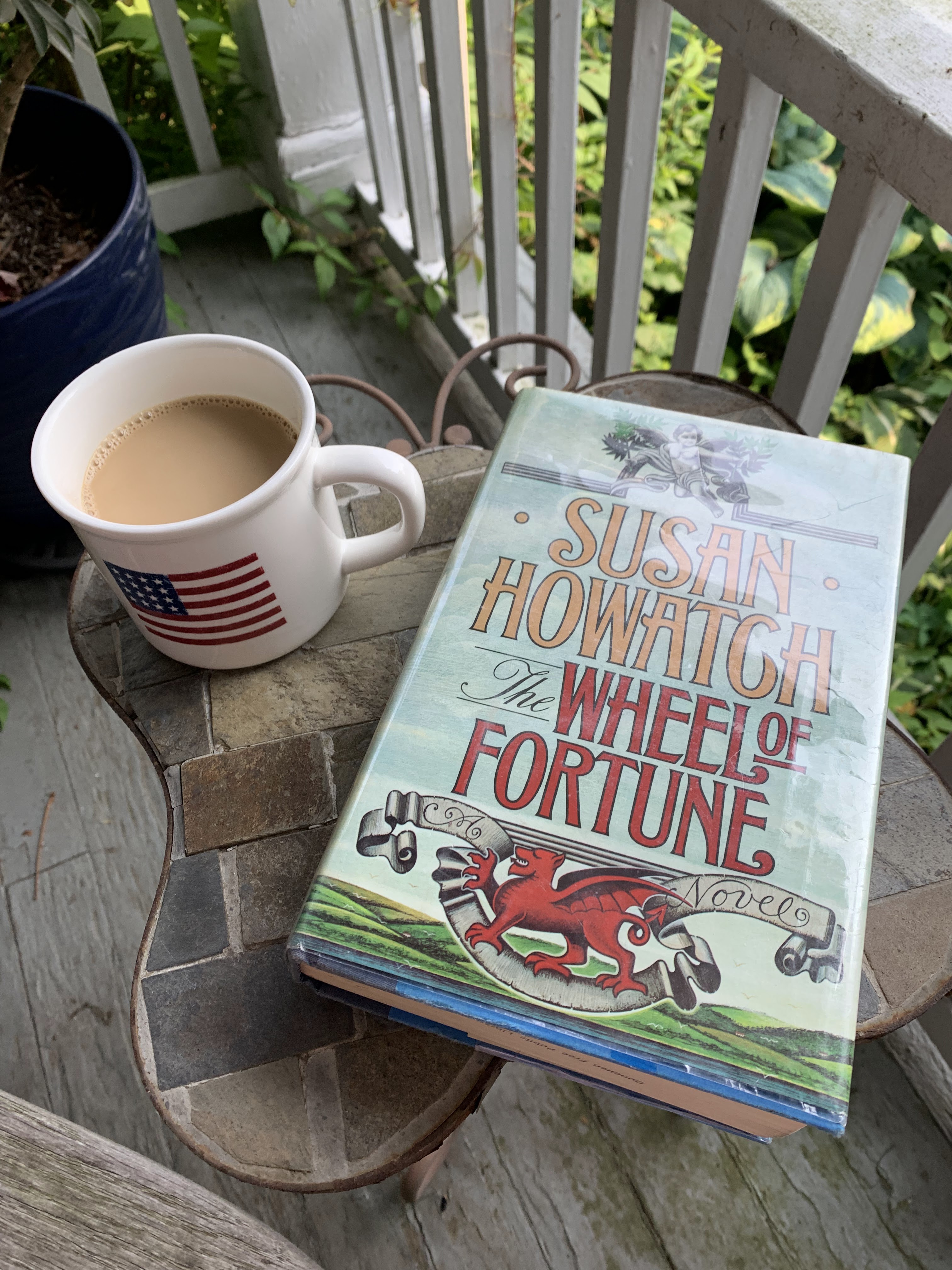
Monthly Book Report: Wheel of Fortune


For most of my adolescence, I loved to read historical fiction.  I consumed books about Eleanor of Aquitaine and Queen Elizabeth and read the entirety of the historical biography section in the school library.  I read other books as well but books set in another place and time were my personal sweet spot.  Weirdly, I did not enjoy history in school, where the subject was most often boring and crusty; taught be a series of teachers who were the same.  Only in books was history splendid.   In college, I discovered that academic history could be amazing; soon after that I became a History and Political Science double major. 

The subject of this month’s book report - all 980 pages of it - is historical fiction.  The story begins  in the late 1800s.  the story of a family - the Godwins - and their Welsh estate, Oxmoon.  Loosely based on the real-life story of The Black Prince and his wife, Joan of Kent, the novel is utterly compelling. I had read the novel before - back in the 1980s when it was originally published - and all I could remember was that I loved it.  When I saw it on the shelf at my local library, I grabbed it right up.

Told in six sections, each narrated by a different member of the Godwin family, the story moves from the 1880s to the 1960s.  Each narrator explains their version of the events unfolding and they layer on information about events that have already happened.  The result is a rich and compelling story about one family, but they are people who stand in for families everywhere, with their truths, those that matter in the long run as well as those that don’t.   Howatch writes beautifully and richly.  The leisurely pace of the story matched the relaxed pace of Summer for me.  I have hours to read and the novel offered hours of reading…that is my perfect (and happy!) sweet spot.  

Tuesday, January 31, 2023

January Book Report: Invisible Child by Andrea Elliot

 I read Invisible Child for the faculty book club at school.  I knew of the story from having read some of it in the New York Times, where Elliot worked as a reporter and first conceived of the story.


The book follows the life of a girl named Dasani, born in 2001, and 8 years old and living with her family in a homeless shelter in Brooklyn when the story begins.
  We follow Dasani, her parents, and her seven siblings for 10 years.  Elliot’s account is both compassionate toward Dasani and her family and condemning of the discordant and failing maze of social services for homeless families in NYC and, I suspect, the nation.

Dasani and her family are Black and that clearly has an affect on them.  They are homeless and often hungry.  They rely on a social services network that is painfully bureaucratic even while it spends millions of dollars each year without securing safe housing for children and families.  There are more than 75,000 homeless children enrolled in NYC public schools and Elliot’s account of the schools - especially McKinney Middle School in Brooklyn - reveals that these institutions are staffed by teachers and administrators who truly care but who are also trying to provide  education as a balm and solution amidst a torrent of disasters that befall poor children.  It’s too great a task in far too many cases.

 Elliot’s account of ACS and NYC social services is less compassionate.  Though sometimes staffed by people who genuinely care they are just as likely to be overwhelmed by rules and bureaucracy.  Services and care are often dismal as a result.  Since we are talking about children and families, dismal is a disaster. 

At one point, Dasani and her siblings are in foster care - separated from their parents and one another - at a cost in excess of nearly $50,000 a month.  That kind of money would - of course - be better spent housing, clothing, and feeding the family than it would be balkanizing them.  The separation is disastrous for many of the children, not to mention their parents.  The children who do survive it, do so with social and emotional wounds that may haunt them for the rest of their lives.  The best outcome is for a member of the family to be limping along but never thriving.

It is well-known that I prefer a happy book.  This story is not happy.  But it was utterly compelling and revealed a family that had complicated needs and problems but always - always - had love.  In that, there is happiness of a sort.  Love is clearly not enough but it is a start and a social services network that keeps that knowledge at its core might be able to truly help.  It should never be acceptable in this rich nation for a child to be hungry or homeless.  The problems that result from that are assuredly complex.  But, as Elliot thoughtfully demonstrates, the cure need not be worse than the condition itself.  

Tuesday, August 10, 2021

The Waning Days of Summer Reading

The arrival of June moves my reading habit into its highest gear and all Summer long, I consume books with a greater ferocity than usual.  Since the pandemic, I’ve taken to using my generous sticker collection to make bookmarks and in the Summer, each book gets its own bookmark. I make them by the gross because they make me happy.  I started a new book the other day and, as is my habit, chose a new bookmark.  As it’s August, the supply has thinned.  


But not so much that I had no choice.


As I reviewed my options, a horrifying thought arose: Summer is coming to a close.  Classes start in 4 weeks.  That development will markedly slow my reading ways.  I’m not quite ready for it.

Sunday, February 28, 2021

February Book Report: All the Light We Cannot See

I have had this book on my to-be-read list for quite some time because it is the sort of book that ticks all my boxes: about Europe in WWI, with two young people at the core of the story, a narrative told by an omniscient narrator…..all the things I am bound to love in a book.  


I am the sort of person who saves a good book for just the moment that I need it and as our February opened with vast amount of snow while T and I finished out our quarantine, I picked up All the Light We Cannot See, by Anthony Doerr.


The book did not disappoint, which is a gross understatement because this book is simply splendid.  The story unfolds gradually at the start of WWII and is mainly told from the point of view of Marie-Laure, a blind girl living in Paris with her father and Werner, an orphan in Germany who will be given an education and then opportunity by the Third Reich, things that he comes to recognize as the double-edged sword they are.  


That the two will come to know one another is clear from nearly the outset of the novel and as Doerr weaves together to story of that meeting, there are beautiful reflections on the nature of love and responsibility, the meaning of the lives regular people live, and the power of a story and sound to lend meaning and vitality to our lives.  To me, a voracious reader and radio-listener, there was such familiarity in those things.  


Doerr can turn a phrase and he won’t be hurried,  two of the very best things about the novel.  He doesn't underplay the horror of war, but reminds us of our humanity amidst it.  I’ve only read the book once but I know that will come back to this novel again and again, to savor the story and Doerr’s reflections on the human condition.  I finished it a few weeks ago but I am still savoring it.  This is the highest complement I can pay a book and I pay it gladly!

Saturday, February 29, 2020

February Book Report: The Young Clementina


I’ve been a fan of D.E. Stevenson books for the last few years.  Stevenson was Scottish and wrote in the mid-20th century.  She was prolific, writing over 40 novels over the course of her lifetime.  Some were written as series; others as singletons.  All are a treat.  I absolutely love Stevenson’s Miss Buncle series.  This month’s book was another of her works,  The Young Clementina.  


Like all the Stevenson books I have read, it has a well-developed story at the core.  The novel is filled with well-drawn characters and a narrator who is sympathetic to them all (well, right up to the moment when they no longer deserve sympathy).  There is amusement and wisdom in the story, which turns on the life of Charlotte Dean, who, after a series of complications,  is asked to look after her young niece Clementina.  Charlotte takes on the task out of a sense of duty and obligation and, despite the challenges, makes good on the job despite some difficulties that befall she and Clementina along the way.  In the end, Charlotte get a happy ending.  As she is a woman who very much deserves the happiness that Stevenson’s story serves her, that felt right.  I always love a happy ending and I enjoyed this story very much.

I will continue to keep my eyes peeled for Stevenson books.  They are always entertaining, filled with amusing characters and the sorts of comeuppances and happy endings I most enjoy in a book.  

That’s happy!

Tuesday, February 18, 2020

Competitive Reading


Yesterday afternoon, I curled up on the sofa with my current book.  I’m nearly done reading it so, as is my habit, I had two others nearby, nominees for the next book I will read.  At some point, T came downstairs and found me there, asleep with three books on my lap.  When I woke up, she teased me about it, amused that I took to the sofa with three books, as if some sort of book apocalypse might befall me there in the living room.

I defended myself by pointing out that I am nearly done with the book du jour and was auditioning candidates for my next read.  She laughed but I could tell she thinks I am a crazy book lady.  As I am in fact a crazy book lady, I took no offense.

I record books that I have read on Goodreads and, in keeping with my competitive spirit, participate in their yearly Reading Challenge, whereby you pick a number of books you expect to read in the year and the app records the books.  This morning,  I logged in to record the book I finished the night before.

At this point, Goodreads informed me that I am behind in the reading challenge for 2020.  Though this is an entirely artificial matter and there is neither reward nor bragging rights involved (I am private on Goodreads and so no one but me sees it), I am quietly freaking out.  Behind on reading?  Me?  What will become of me?  How will I face myself each day?  And most importantly.....How can I read more?

It is ironic that this terrifying news happened less than 24 hours after I fell asleep on the sofa with three books in my lap.    I feel like Goodreads needs to check in with T, who can attest to my bona fides as a good reader.

Friday, January 31, 2020

January Book Report: Emma


In preparation for the February release of a new Emma movie, I got out my copy of the Jane Austen classic this month.  


This book is a delicious treat, as is the case with all things Jane Austen (I’m watching Sanditon on Masterpiece Theater this month and it’s been pleasing).  In Emma, the dialogue is clever and witty.  The characters are an assortment of Austen’s carefully drawn quirky townspeople, at least a few of whom are especially tiresome and somehow still quite charming.  In short, the book is delightful and the story pops right along.  I’ve read Emma so many times that I can anticipate my favorite scenes.  For me, a committed re-reader, this is especially pleasing.

Every re-read finds me aware of something new in the novel.  This time around, it was a reminder about the limited world of educated women in the 1800s.  Emma, who works as a matchmaker for the women around her, resists marriage for most of the novel, preferring to stay home and care for her charming (but hypochondriac) father.  Her resistance to marriage is about her father but it’s also about having the chance to shape her life for herself.

In the end, of course, Emma does choose marriage.  In her case, it’s without giving up her sense of self.  As is the case with all Austen novels, the reader gets her happy ending.  But this is no saccharine event, accompanied as it is by the voice of an all-seeing honest narrator.  Emma was a cozy pleasure in January.  Plus, I’m ready for the movie next month!

Tuesday, December 31, 2019

December Book Report: Frederick Douglass: Prophet of Freedom


David W. Blight’s thorough and thoughtful study of the life of Frederick Douglass is a heavy lift - literally.  At more than 750 pages, it’s not a quick read.  But it should be essential reading for our nation’s civic well-being, especially now, when our leadership’s collective ignorance about our racist history is so damaging to our ability to move forward together.

But I digress and that’s not fair to Frederick Douglass., whose incredible life and words are at the center of this book.

Born enslaved to a mother from whom he was separated before he ever had a chance to know her, Frederick Bailey learned to read thanks to Sophia Auld, a kindly slave mistress who had a fondness for the young boy who worked for her family.  When her husband learned that the enslaved boy had been taught how to read, he angrily ended the lessons, telling his wife that Frederick the reader was now, “forever unfit” for life as a slave.  The lessons stopped, but Frederick continued to read.

By then, the enslaved child’s fondness for and joy in reading was a settled fact.  In the coming years. as he was frequently denied the ability to read, Douglass’s fury about slavery would grow.  When he made his escape to the North at the age of 20, his ability to read helped him to make the journey successfully.  For the rest of his life, words that he read, spoke, and wrote would be at the center of Frederick Douglass’s existence.  His enduring importance and influence in this nation is a direct result of the words that fed his reader's soul and then poured from him.

The power of reading is not the only lesson to be taken from Blight’s amazing portrait of Douglass.  The book is a discourse on Douglass and his many contributions to the freedom that America celebrates.  There is abundant and shameful irony in the fact that those freedoms were given much greater meaning by a man born into slavery, and that reality was never lost on me as I read about Douglass’s life and his contributions to our national history.   My copy already has multiple pages marked to use as I teach about Douglass later this school year.

But to me personally, one of the most poignant aspects of Douglass’s story is in the simple power of reading.  I was a late reader as a child.  When the spark finally caught in the third grade, I was consumed by it.  Reading became my most absorbing passion and it opened worlds for my imagination.  I am a history teacher and thoughtful citizen because of the books I read.  Reading informs the person I am and the person I try to to be.  In so many ways, books fuel my world.  To know that Douglass’s world was similarly inspired by the power of the written word is thrilling.

As thrilling as the story of Douglass; as thrilling as the power of this incredibly important book.  In my mind, it's required reading for this nation.

Wednesday, September 11, 2019

Bookish


I start every summer with a pile of books to be read.  For the most part, I make steady progress through that pile, picking up a new read every week or so.  Books get added to the pile when the mood strikes; others are set aside for a different time.  The existence of a list of to-be-read books is a source of enduring happiness for me; a way of looking forward with ease in my heart.  I see it as a comfort; as a way of looking after myself.

Books are that way for me: comfortable friends who make life richer and happier.  Summer’s relaxed pace and long, warm days ensures that I have plenty of time to sit on the front porch and read.  Come September, mornings on the front porch are too dark to read.  If there is time when I get home, I will steal it on the porch with my current book.  But it’s not as dependable as it is in the Summer. and now it feels like a treat  In the busy days at the start of school, there’s no time to mourn the seasonal transition.  That waits for Winter, when I cozy under a blanket on the sofa and look out the front door to the porch, marveling at the hours I spent out there just a few months back and sometimes longing for the ease of days when I can step outside in flip flops without fear of frostbite.

Seasons change; my habits do not.  I read whenever I have the time.. There is less time when school is in session but I travel everywhere I can with my book. I grab the time that is available.  I maintain a list of books to be read and eagerly look forward to my next read.

That’s happy!


Monday, December 31, 2018

December Book Report: Last Christmas in Paris


The arrival of the holiday season and some much-welcomed time off  brought me some extra time to read, a welcome way to close my year.  I picked up Last Christmas in Paris, a novel written by Hazel Gaynor and Heather Webb, because it looked like just my sort of satisfying read.  I was right about that.


This book is set during WWI and, as 2018 closed it seemed fitting to spend some time thinking again about this war.  This year is the 100th anniversary of the armistice that ended WWI and in so many ways the 20th and 21st centuries were defined by this horrible war.  The historian in me is endlessly fascinated by the conflict.  The reader in me likes a good story and this one, recommended by the reviewers at Bas Bleu, was a great read.

The story is told from the English point of view in a series of letters exchanged between a young woman, Evie, who is just an adult as as the war breaks out.  She writes to her brother and other friends who are deployed in France and the exchanges are the backbone of the novel.  As each year of the war closes, the reader is treated to an observation from 1968, as an ailing Tom, a frequent recipient of Evie’s letters and now at the end of a long life, reviews the years of the long-ago war.  He's in Paris, where he has come to spent his last Christmas.  

The novel is written in letter format (think Guernsey Literary and Potato Peel Pie Society) and, like that novel, has reflections on both the horror of war as well as the more mundane aspects of life lived while at war.  Evie exchanges letters with a handful of people and, like many young women of that era, realizes that she wants more from life than the narrow social confines of her privileged upbringing.  For one thing, that privilege doesn’t protect her from the losses of the war and, for another, she craves the ability to help out.  She eventually comes to write a column about the war on the homefront and though the reader never experiences Evie’s life after the war, we do come to understand that the war will open up enduring opportunities for her.

Much of the novel’s letters traffic in the hope that WWI will be the war to end all wars, an idea that the characters both embrace and believe.  Given the history that would follow, the notion is especially bittersweet and gives the reader much to consider.  The novel is well-written, with a strong sense of the historical time and engaging in those details.  I enjoyed it even more than I expected and it has earned a spot on my bookshelf.

Friday, November 30, 2018

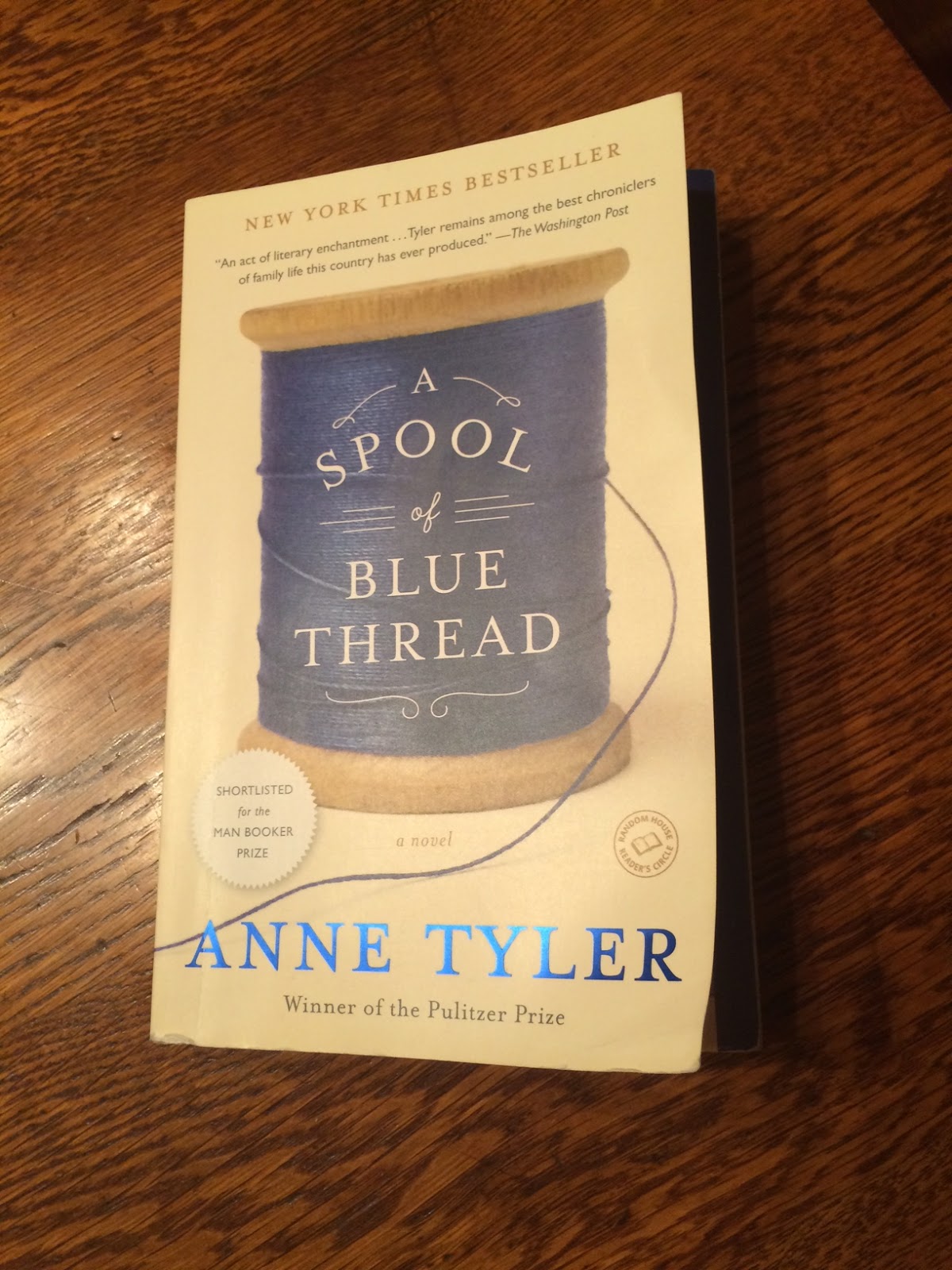
November Book Report: A Spool of Blue Thread


This book is like so many Anne Tyler novels, centered on a family with its own faults and quirks and set squarely in the Baltimore that Tyler so clearly loves.  It’s the story of the Whitshank family, who appear like any typical family on the surface and, like so many typical families, are anything but typical in the quirks and fault lines that reveal themselves as the novel unfolds.

I pick up Anne Tyler novels when I’m in the mood for a meaty story about a family.  I am a reader who likes happy endings and Tyler offers no guarantee of those, but neither do her novels end with dramatic sadness.  The book was an entre into a family not much like my own but, because it is a family with all the emotions families feel, it was familiar.  It was rather an easy read but also a story that lingers well after I read the last page.

Tyler is an artist; a capable and adept writer who constructs characters both sympathetic and tiresome, both awkward and adept; people who are recognizable in their very humanity.  I enjoyed this book and have thought about the story since I read it.  That’s the magic of an Anne Tyler book.  

Monday, April 30, 2018

April Book Report: The Sympathizer


Last month’s book report was a novel I read with a group of teachers considering a collection of books for an English course on identity in the United States.  I read this month’s book report novel for the same potential course and, like last month’s book, it was a simply splendid read.


The Sympathizer, written by Viet Thanh Nguyen, opens in Vietnam in April 1975, as Saigon is about to fall to the Viet Minh.  Our nameless narrator lives in Saigon, serving as the aid to a Viet Cong general.  He is arranging flights for the general and his allies on American transport out of Saigon in advance of the fall to the communists.  But things aren’t quite what they seem and our nameless narrator is a double agent, reporting to Viet Minh intelligence even as he works with the Viet Cong.

The narrator successfully escapes Saigon and finds himself in southern California, part of a refugee diaspora who’ve lost not only their home country but also their identity.  As the group transitions from the lives of prosperous senior leaders in once-sovereign south Vietnam to the lives of poor Vietnamese refugees in America, the narrator’s observations are cogent and critical, but also amusing.  The narrator speaks English well, having studied at an American college in the 1960s.  Mixed race himself (the son of French priest and a Vietnamese mother) he is somewhat comfortable as an American, though still an outsider.   But that is an identity with which he is familiar, having grown up in a Vietnamese society uncomfortable with his mixed-race status.

Large portions of the book feel like something of a jaunt through 1970s southern California, as our narrator lives an existence without making a life for himself.  Still in communication with his Viet Minh commander, he seeks a greater meaning for himself even as he becomes increasingly angry with the American understanding of the Vietnam War and the Vietnamese people.  Holding on to the comforting notion that communist rule in his home country must be good for people, the novel races to a conclusion that will challenge that assumption.

Like Adichie’s Americanah, The Sympathizer provides the reader with critical observations of American life that are at-once amusing, pointed, and often quite uncomfortable.  Both narrators understand the United States and have a certain fondness for it, but neither has an unvarnished view.  Whereas both Adichie and the protagonist of her novel can travel back and forth between Nigeria and the United States, Nguyen does not enjoy that luxury.  A refugee who came to the United States at age 4, the author no longer has a home in his birth country.  He is American, for better or worse, and writes of that as an experience of feeling somewhat adrift from a home.  

As a writer, Nguyen seems to have talent to spare and the novel has his faculty with words and descriptions on full display.  The pages flow one into another and despite the difficult topics being explored, it reads easy.  The book is brilliant and as I read it, I found myself looking up essays, interview, and editorials with Nguyen.  He’s an author I’ll recommend to others and read again and again.

Saturday, March 31, 2018

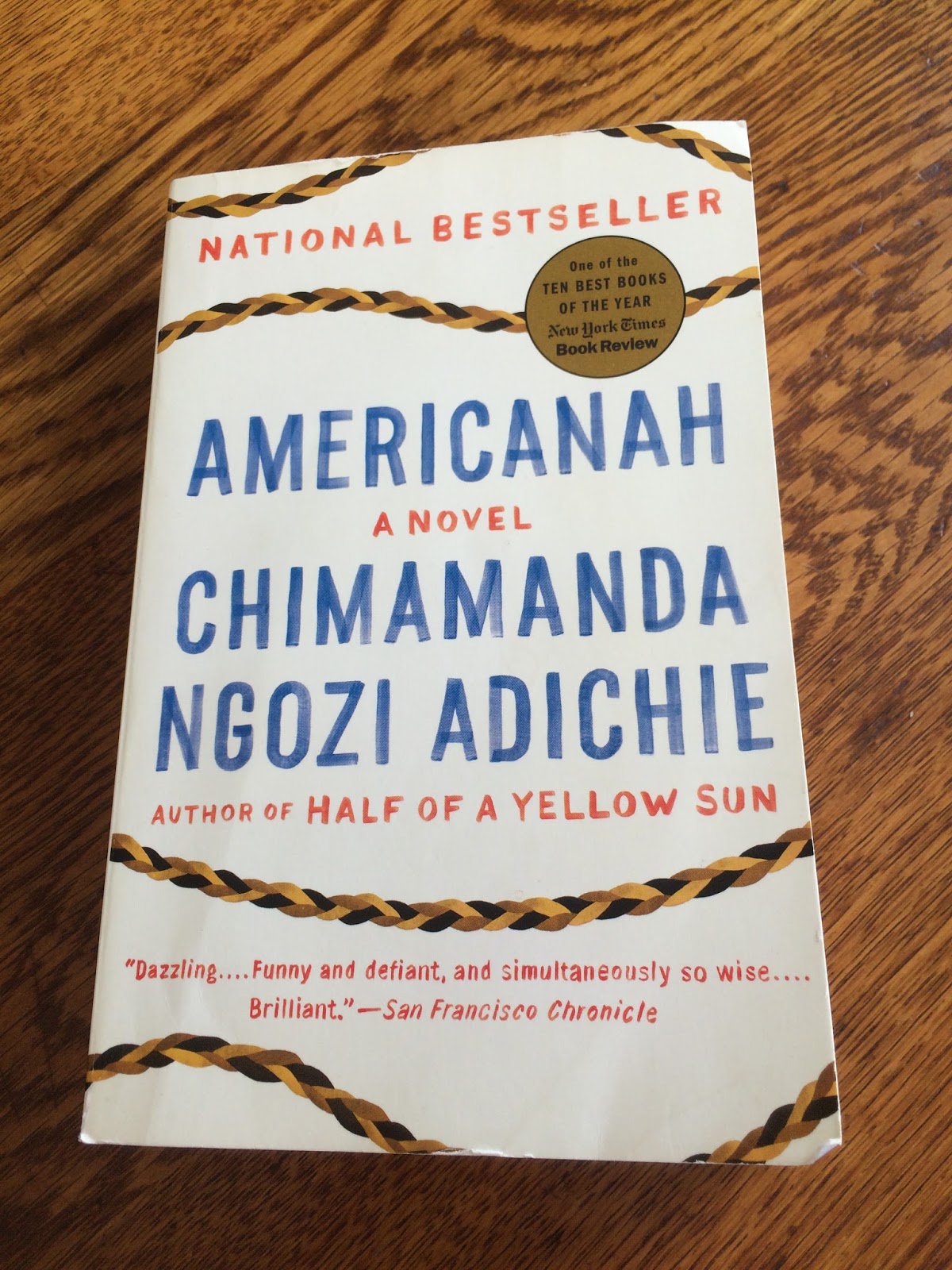
March Book Report: Americanah


I had listened to Chimamanda Ngozi Adichie’s TED talks, heard interviews with her on NPR, and was otherwise aware of her work before I picked up Americanah.  I finally read the novel in preparation for a faculty book group meeting next month.  I figured that I would like it but despite my familiarity and enjoyment of Adichie’s ideas and other works, I wasn’t at all prepared for the brilliance of this book, which I absorbed and keep thinking about.


It is indeed brilliant, with both the hard shine of cogent social and political criticism of the United States, England, and Nigeria, and the radiant humor and joy of life that the both the author-narrator and her primary characters demonstrate.  I loved this book.

The opening scenes of the novel happen in New Jersey, as the center of the story,  Ifemelu, makes the short journey from the mostly white, liberal, privileged enclave of Princeton to Trenton, where she travels to have her hair braided.  It’s just 13 miles away but rather a world apart and the juxtaposition serves as the central contrast in the novel.  The book is one-part story and one-part conversation about race and ethnicity in America and England as compared to life in Nigeria, where Ifemelu grew up aware of being Nigerian but not aware of having a race. 

Her arrival and 15 year experience in the United States makes Ifemelu aware of race and identity in a whole new way.  The experience is both alienating and informative and Adichie’s reflections here are both uncomfortable and absorbing.   The reader also sees England through the eyes of Obinze, Ifemelu’s high school boyfriend, also an immigrant in a new place finding his way through racial and class confusion.

Though the criticisms are sticking and real, Adichie also shows her affection for these places that make up her characters’ worlds and also her own.  As the author and observer, she seems to move easily between these places, even while Ifemelu and Obinze struggle to do the same.  Adichie understands their journey and it shows.  I loved this book for both the story at the heart of it and the often biting but always thoughtful criticism that ran throughout.  That’s the essential talent of Adichie’s writing: the ability to ask the reader to critically examine her nation without being cruel or hopeless in that lens.  This book has lingered with me long past my reading of the last lines.  I look forward to reading it again and again, the highest complement I can pay a book.

Saturday, September 30, 2017

September Book Report: The Angry Tide

I picked up The Angry Tide to read as the school year began, confident that it would be a welcome respite as I settled in to busy school days.  I was right about that.


The novel is the seventh title in Winston’s Graham’s Poldark series.  I’ve written before about the series and how much I love these books, you can read that here and here.  The novels, set in Cornwall in the same time period as the American Revolution and into the early 1800s, are terrific stories on their own, with interesting characters woven throughout.  I’ve enjoyed every book in the series and together, the themes of the novels linger well past the reading of the books.  

The stories are parables of privilege and work; of responsibility and happiness.  They are stories of class and feminism.  Graham has an impressive talent for showing the reader all of the characters’ points of view in a well-drawn way, sometimes sympathetic to them, sometimes not.  He’s never unkind but neither does he gloss the truth of each character’s existence and behavior.  Each novel has been a great read, with experiences and turns of phrase I think about well after I’ve turned the last page.

Tomorrow, the Poldark series begins again on Masterpiece Theatre and it’s nearly as well-done as the novels, with beautiful images to boot.  Like the books, it's well-worth your time.

Friday, June 30, 2017

June 30 Book Report: All Thrush Green, All the Time

I ended the month of May by reading Thrush Green, the first book in Miss Read’s series about an imaginary Cotswold neighborhood.  The stories feature the towns and residents of Thrush Green, Lulling, and Nidden.  They are about the pleasures and challenges of everyday life and are full of both humor and wisdom about the human condition.  I first read the books in 2006 and every few years I return to the series to pick up a few of the books.  In June, while my house was in upheaval and I was visiting colleges with JT, it seemed like a very good idea to once again spend some time with these very familiar friends.


There are twelve books in the series and I’ve spent the month of June making my way through them, enjoying the familiar comforts of these old friends and the luxury of time enough to read every book in the collection.  They remind me to smile and laugh, to admire the seasons, to live in the here-and-now, and to appreciate the comforts of the most simple pleasures in life.  From loved ones and cups of tea to a well-polished window and a bloom in my garden, these books remind me of all my blessings.  Thrush Green is the world and people at their best, a most welcome place to spend my time.