Monday, July 31, 2017

Garden Report Week Nine: Monday, July 31

It’s rather hard to believe that we’ve reached the August portion of summer.  The growing garden suggests it’s true…


…though the recent mild days suggest otherwise.  I’m off work for the rest of this week and plan to enjoy some quality time in my garden.  If I get extra-lucky, there will be tomatoes for me to enjoy.  That’s happy!


July Book Report: News of the World

I picked up News of The World, by Paulette Jiles, on a Friday afternoon at the library.  The cover was intriguing and a quick read of the inside leaf suggested that it was my kind of story.  Set in post-Civil War Texas, the story opens in 1870.  Captain Jefferson Kyle Kidd, a veteran of Jackson’s Indian campaigns and the Mexican-American wars, is a circuit rider who visits northern Texas towns and reads newspapers to the townspeople who pay a dime to hear the news.


Too old to fight in the Civil War, Captain Kidd is still a victim of that war, which cost him his printing press and his land. Now a widower whose adult daughters live in Georgia, he travels land that borders Indian territory and enjoys the travels.  He avoids local political news, sure to cause conflict in lawless post-Civil War Texas, in favor of news from places from far away.  The nomadic life suits him but also lands him in an awkward situation, the recipient of a ten year girl who had been captured by Kiowa Indians at the age of six.  Raised by the tribe since then, she looks German-American but only speaks Kiowa and has embraced their sensibilities.  The tribe has reluctantly turned her over to an Indian agent thanks to U.S. policy which sent military troops after tribes with white captives.  Johanna, like most child-captives, is the unfortunate victim of the policy.  Having been embraced by the Kiowa tribe, she is fully a part of them, and the handover to Captain Kidd finds her culturally isolated and mourning the only family she can remember.

Kidd’s task is to return Johanna to her Aunt and Uncle, who farm south of San Antonio.  It’s a dangerous three-week journey and he undertakes it with profound reluctance, less concerned about their safety than he is annoyed by the responsibilities of the girl and his regular recollection that he has already raised two daughters.  The story which follows is a lyrical and lovely reflection on the nature of life and family, with vivid descriptions of the Texas landscape and richly imagined characters.  As Kidd and Johanna come to know one another, their definition of family expands.  The fullness of life they find from one another is lovely but not sentimental.  Page after page in this book is filled with sweetly powerful reflections on the human condition.

Regarding his plan to read the news from far away, the narrator tells us Captain Kidd’s thinking, “If people had true knowledge of the world perhaps they would not take up arms and so perhaps he could be an aggregator of information from distant places and then the world would be a more peaceful place.  He had been perfectly serious.  That illusion had lasted from age forty-nine to age sixty-five.”

Kidd is a Union man in divided Texas, but he’s not without sense of the cost of the war, as the narrator explains, “No matter what side you were on, if you had survived Gettysburg, you were to be congratulated.” 

When their journey south is threatened, Captain Kidd finds that he’s not alone as he mounts a defense.  The narrator explains it to the reader,  “The girl sat in the wagon bed behind wrapped in the thick red and black jorongo.  There was no method by which he could explain anything to her but she did not need explanations.  Her family and her tribe had fought with the Utes, their ancient enemies, and the Caldos.  They had conducted long guerrilla warfare with Texas settlers and Texas Rangers and then with the U.S. Army.  Often enough they had faced the howling, striving demons of the open plains: hunger, tornadoes, scarlet fever. She didn’t need to be told anything except that there were enemies in pursuit and she had already figured that out.”  

After an attack is repelled, the Captain finds himself needing to explain the culture Johanna must now join.  She wishes to exult over the vanquished but the Captain responds, “No. Absolutely not.  No. No scalping. He lifted her up and swung her over the ledges of stone and then followed.  He said, It is considered very impolite.” 

As the journey to San Antonio unfolds, the Captain has time to reflect on life and the passage of time.  The narrator explains his thoughts, “Maybe we have just one message, and it is delivered to us when we are born and we are never sure what it says; it may have nothing to do with us personally but it must be carried by hand through a life, all the way, and at the end handed over, sealed.” 

In a reflection on his growing fondness for Johanna, Captain Kidd finds a wisdom that applies to circumstances well beyond his situation at the moment when he considers that,  “He would have liked to kiss her on the cheek but he had no idea if the Kiowa kissed one another or if so, did grandfathers kiss granddaughters.  You never knew.  Cultures were mine fields.” 

This book was a powerful journey through an historical time and place different from my own, though both are twisted with uncertainties.  I read the novel in a weekend because it was nearly impossible to set aside.  The timeless reflections on the human condition were a comfort to read.  I expect that I will come back to this story again and again.


Sunday, July 30, 2017

Backyard

Birds are chirping and for a few brief moments, no one in town is operating their yardwork power tools.


Summer, you are so very lovely.

Saturday, July 29, 2017

Lifetime Limit, Edition 2

The backstory: As is the case with any sentient person, I spend plenty of time in the public places that feature music from the easy listening/classic rock continuum.  Over the years, some songs have lost their appeal.  To that end, T and I have compiled a list of songs which have achieved their lifetime limit, meaning that we never wish to hear them again.  Over the remainder of 2017, I will post nominees for this dubious honor.  

This edition is concerned with rock ballads, a genre that has a great deal for which to answer.  For starters, the tunes whine in your head long after the song has been heard.  Moreover, they all have horrifying videos that still come to mind when I hear them, even though it’s been a solid 20-plus years since I watched any of these videos. Or perhaps any music videos?  Do music videos still exist? But I digress…..the following songs are tiresome and I have reached my lifetime limit.  

1.  All songs by Whitesnake, but especially “Here I Go Again on My Own.” Just fucking go, already.

2.  Poison’s “Every Rose Has It’s Thorn,” which is both an appallingly trite sentiment and frightfully likely to linger in your brain long after the first thorn-related damage has healed.  

3.  I’m a bit reluctant to place Journey’s “Open Arms” on the list because if I never hear it again, I will never have the chance to share a timely laugh with my sister about the time my mother claimed the song was named “Velvet Arms.”  However, in the interests of the common good, I feel obligated to declare I’ve reached a lifetime limit on this damned song.  While I’m at it, I’m also declaring that we’re done with “Faithfully.” 

May your weekend be pleasant and ear-worm free.

Friday, July 28, 2017

The Power of Powerlessness

As I plan my Harriet Tubman lessons for the 7th grade, my mind continues to whirl with the story of Tubman’s life.  Born to the Ross family, as a child she was known as Araminta.  She chose a new name when she escaped to freedom in 1849, calling herself Harriet after her mother.  It was a reinvention that led to freedom for more than 300 other people, all at the hands of a woman once enslaved. It’s a story with lessons that resonate today.

When Araminta Ross was six,  her father Ben had to stay behind while his wife and children when were sent to work 15 miles away, at a farm belonging to Edmond Brodess in Dorchester County, on the eastern side of the Choptank River.  There, Araminta looked after children, worked in the fields,  hunted muskrats, and found that she was a good observer of the outdoor world.  Her father had taught her to identify the North star so that she could navigate home after dark and as she grew up, she cultivated more knowledge of the outdoor world.  As a teenager, contracted out to work for slavemasters in Cambridge, a harbor town, she mingled with free black men who worked the Chesapeake waters and taught her about the river and the tributaries and creeks along the Eastern shore.  They also told her about life in the North, where freedom beckoned.  The presence of Quakers in the region ensured that those who sought freedom from slavery might find help.  

Free and enslaved African-Americans in the world of Chesapeake, Maryland, moved amongst one another.  They intermarried, with freemen sometimes having children by their enslaved wives. Araminta Ross became Araminta Tubman when she married John Tubman, a freeman.  Children born to enslaved mothers were themselves enslaved and families of this kind faced the constant risk of separation.  White slave owners in the region treated their slaves as an investment and when debts needed settling, they didn’t hesitate to sell their enslaved property to slave traders at the wharves in Cambridge, who would arrange for the human property to be shipped off as cargo to plantation owners in the deep South.  If this occurred, families would likely be separated for good, unable to communicate with one another because they could neither read nor write.  This fate befell two of Araminta Ross’s sisters and it was the threat of being sold away from her family that finally inspired Araminta to try her hand at freedom in 1849.  As she explained to the author of an 1886 biography about her life, "I had reasoned this out in my mind; there was one of two things I had a right to, liberty, or death; if I could not have one, I would have the other; for no man should take me alive; I should fight for my liberty as long as my strength lasted, and when the time came for me to go, the Lord would let them take me.”

When the details stack out, I can see how it was that Harriet Tubman could escape to freedom: she knew the landscape well, the river led north, as did most the creeks, marshes were good places to hide tracks, Quaker settlements in the area were known to oppose slavery, it was less than 75 miles to Philadelphia and freedom.  But she still travelled with the risk of death or a punishment for escaping that might be worse than death, there were still great unknowns,  and she had to repeatedly rely on the kindness of strangers.  To make the journey once was courageous in a way modern life never demands of us.  And to go back repeatedly over a 10 year period to rescue both family and strangers….well that is simply splendid heroism, from a woman born to a world that underestimated her mightily.  

It’s common to claim that the underestimation of her strength is what empowered Harriet Tubman.  But that claim undermines both her bravery and her brilliance.  Vaclav Havel wrote that the power of powerlessness can be found in the refusal to yield to fear.  Araminta found that power and it made her rebirth as Harriet Tubman something to behold.  There is a lesson there for all of us and I look forward to sharing it with the 7th grade.


Tuesday, July 25, 2017

Only Child

There is a hydrangea bush in my backyard.  It’s large and grows in a spot that receives morning sun and afternoon shade.  It looks vibrant but in the twelve years I have lived here, it has never bloomed a flower.  Each Spring, I look for blooms but Summer has never delivered me flowers.  For the last few years, I’ve read up on hydrangea pruning and tried to prune it in late Winter with hopes of Spring blooms.  Just when I had given up hope of success, I have a hydrangea flower.  And not just any flower; a splendid purple flower.


It’s the only flower I’ve got but I’m thrilled to see it.  Gardens surprises are always so very lovely.  

Monday, July 24, 2017

Garden Report, Week Eight: Monday, July 24


This point in the summer often signals the start of a transition to comes, as things that have been furiously growing began to look weary from their efforts.  My basil plants have clearly been a snack bush for some creatures.


The tomatoes are still looking pretty good, though some of the heavy from the past week's storms was rough on some of the bushes.  I've re-staked and I am hopeful the plants will cope nicely.


The zinnia patch is in a hurry to bring me blooms and bouquets.


The sunlight that shines here has a special quality to me because it brings reward for my efforts and the prospect of a fresh-picked tomato on the supper table.


Sunday, July 23, 2017

Wrapping My Mind Around It

JT has been gone for the last two weeks, his annual vacation with his other mother, and I have been in a quiet house for some of the time.  Not all of it —— T and I made one of our annual adventures, and I made plans for some evenings. I worked most of the days,  but I’ve had some evenings to myself.

That’s time to relax and not be a responsible parent (and when you are the mother of a teenage driver, you sure as hell need time off from that).  My house is clean, my laundry is caught up, the TV is mine to watch (and without interruption).  It’s weird and nice in equal measure and a reminder of the lifestyle that is coming my way soon.

It’s strange and sometimes difficult to head into this coming September with the thought that this is my last school year as a full-time mama of a living-at-home child.  On the one hand, it feels like a foreign landscape.  For the first time in nearly 18 years, the prospect of the next season doesn’t just mean snowfalls or tulips peaking through the ground.  The next season also feels like one filled with endings…..the last time I will make JT’s picture on the first days of school, the last snow days JT and I will enjoy together, my final seasons as a parent cheering on her son in an RPS jersey…so many lasts that they stack up in a way that is sometimes hard to contemplate.  I expect that among the uncertainties to come, there will also be blessings to enjoy.  But uncertainty remains part of the picture for now and I’m the sort of person who likes a spoiler, so uncertainty is unsettling.

Of course, it’s easy to miss your 17 year old when he’s been away for two weeks.  When he returns with bushels of attitude, piles of laundry, and multiple expensive requests, it might be a whole lot easier to embrace a future when our paths will diverge.   I am genuinely excited for this next chapter in JT’s world.  It’s thrilling to see a boy who was once every inch a Peter Pan as he walks toward greater independence and autonomy, prepared to actually grow up.  And I’m excited for me and T, as we embark on the next steps in our life together.  For now, however, daily life will once again feature a boy.  And though it won't always be so sweet, I’m looking forward to his loud and messy return.

Flowers & Daydreams

Last weekend’s tour of Harriet Tubman’s Maryland world started with some flowers and gardens in Delaware.  I can never resist making pictures of the flowers I see.  I store these pictures in files for my garden imagination, planning flowers that I will some day plant in my garden.


At Brandywine State Park, there were coneflowers.


At Winterthur, there were all sorts of hydrangeas.


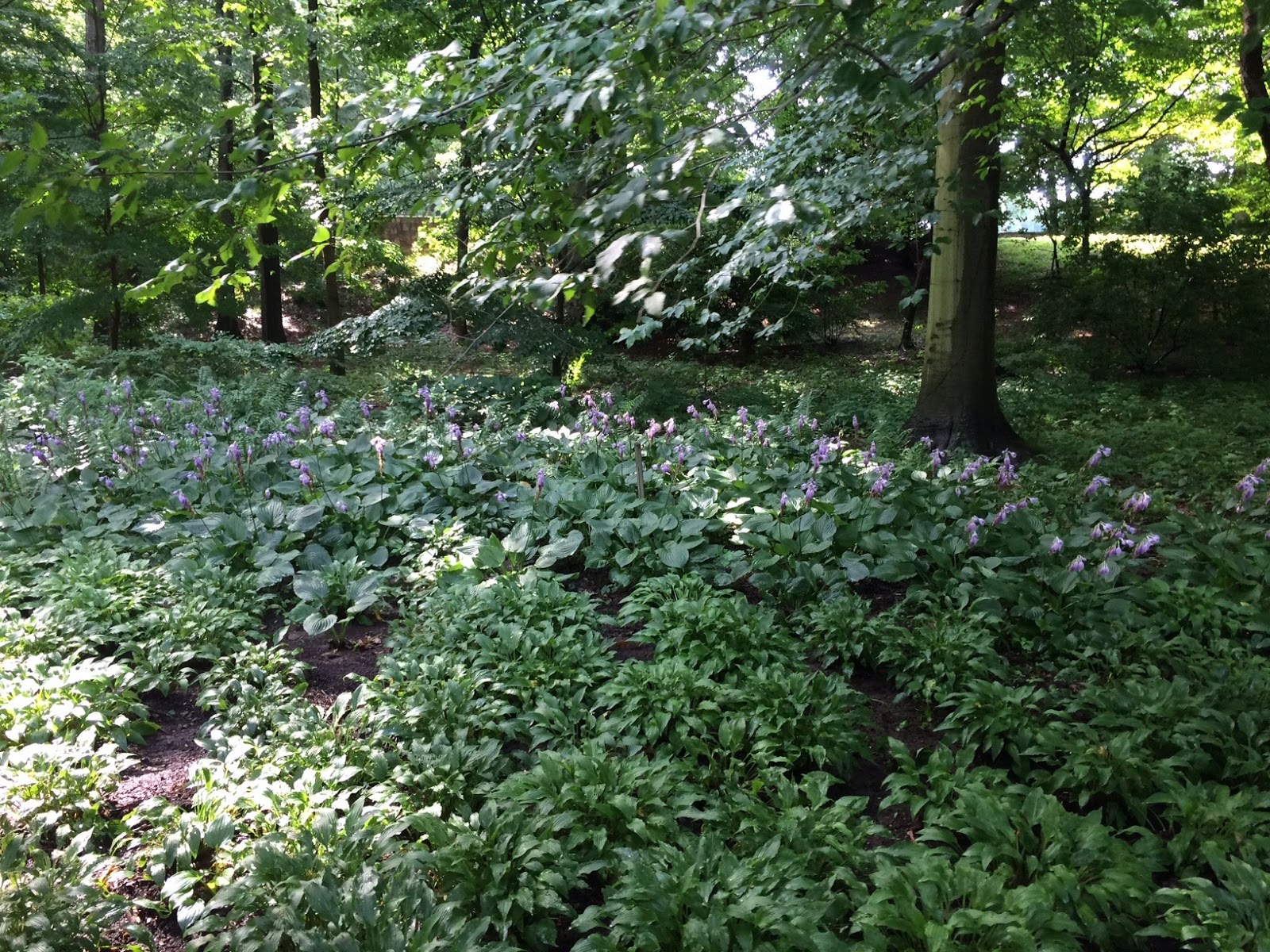
The hostas were in full bloom, looking so very lovely with their stretching purple flowers in the shade of the woods.


The wisteria trained to grow around this shade trellis made me smile.  This sort of project is years in the making.


Gardening encourages and then rewards patience, a lesson that always resonates with me.

Friday, July 21, 2017

At the Eastern Shore

When I was in the fifth grade I read my way through the history biography section of the Weldon Elementary School library.  I read the biographies of important Americans  in alphabetical order and especially looked forward to the stories of women.  There weren’t very many and I savored them.  Harriet Tubman’s biography was short, a fact I noted with dismay before I even got to the letter T and read her story.  What the story lacked in length it made up for in the power and courage of the tale.  From that read forward, I was fascinated with Harriet Tubman.  Adulthood hasn’t dimmed my interest.  Last weekend, T and I made the journey to the brand new Harriet Tubman Underground Railroad National Park.


For the last week, my head has been spinning with thoughts about Harriet Tubman, her life, and her world.  If anything, Tubman’s story is more powerful to me today than it was when I was 10 and for the last seven days I’ve been writing and writing as I try to make sense of what I want to say about her.  This morning I realized that it’s going to take a few posts to get my thoughts in order.  The reason is quite simple: Harriet Tubman is an historical badass.

Born enslaved in 1822 and called Araminta as a baby, Tubman grew up in an unequal world on Maryland’s Eastern shore.  As one of nine children who would eventually be born to Ben and Harriet Ross, she was working by the time she was walking.  Enslavement on Maryland’s Eastern shore wasn’t the plantation system, but it was cruel in a different way.   Maryland slaveowners had farms  but many slaveowners treated the people they owned as investments and they hired out their slaves to be wage workers for other people and places.  Families were regularly separated by distances of 5 to 10 miles, sometimes more.

The Choptank River flows through the area into the Chesapeake Bay at Cambridge, Maryland and was a major influence on industry in the region.  With tributaries in the dozens, people in the region were familiar with water.  The waterways were part of life on the Eastern shore, moving people about. In addition, unlike the plantation South, there were plenty of free black men in the area.  Many worked on the ships that came from North; others were freemen who lived in the region, working the docks and other water-based jobs.  At the time of Tubman’s birth, these free and enslaved populations regularly mixed and even intermarried.

This landscape is central to the story of Harriet Tubman and that’s been my epiphany in the last week. I am also a person for whom place has always been important and as I think about Harriet Tubman’s life and accomplishments, I think of them in the context of place and people.  I plan to use Tubman’s story throughout the year in my 7th grade History class and as I plan those lessons, I will post my thoughts on this blog.